Pieter Bruegel the Elder
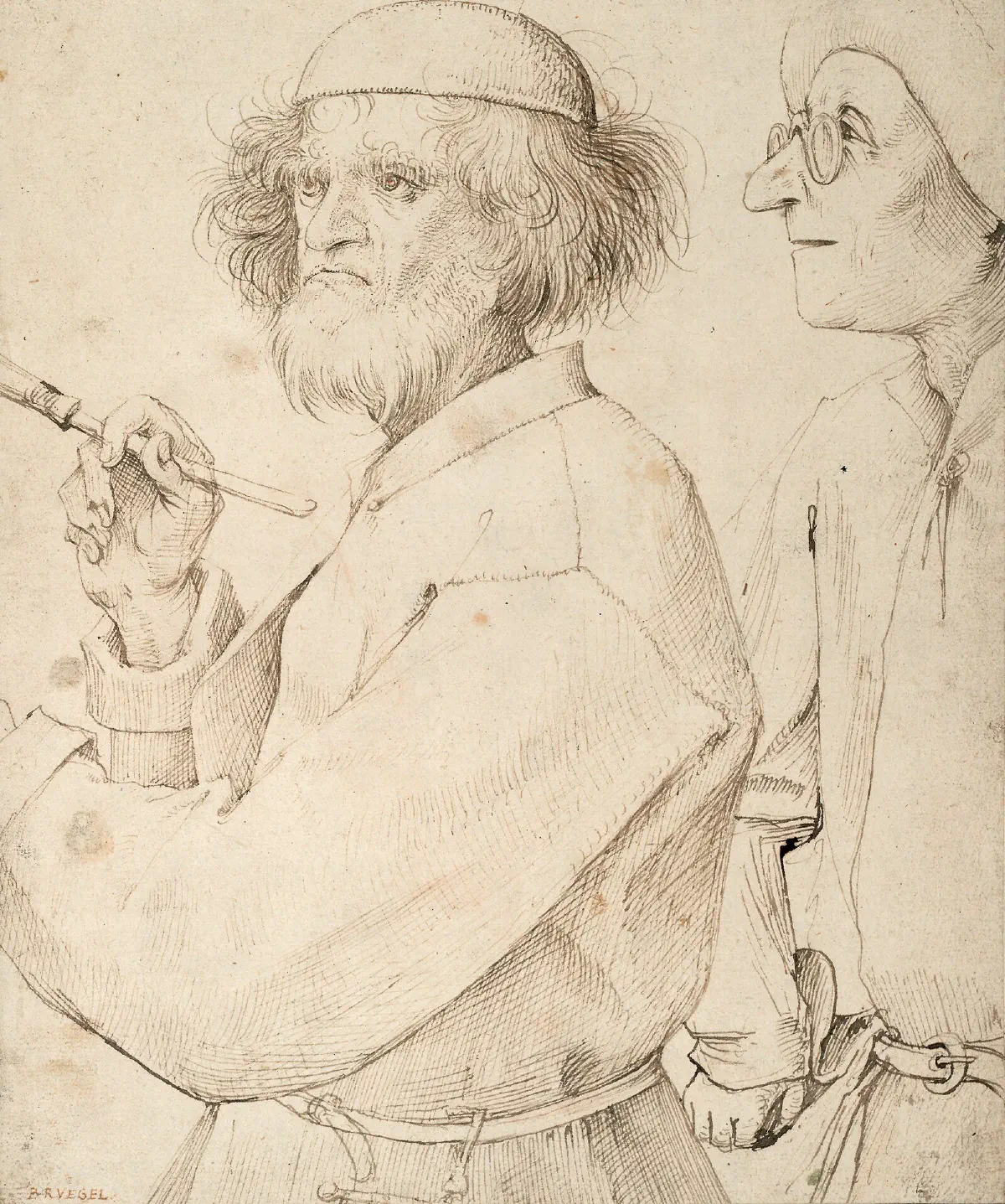
1565 to 1566, Pen and ink on brown paper, Albertina, Vienna Public Domain · SourceA painter and a buyer, face to face
The title gives us a small scene with a big question: what happens when the person who makes art meets the person who pays for it? Bruegel’s career offers no tidy story of an isolated genius. He worked in a world of patrons, publishers, and skilled printmakers—and he made pictures that treated everyday life as worthy of attention.
The image is titled The Painter and the Buyer on Wikimedia Commons and dated around 1566. A related drawing, listed in the Wikipedia article as The Painter and the Connoisseur, is dated around 1565 and held at the Albertina in Vienna. The different titles are a useful reminder not to claim more about the people shown than the evidence allows.
A short life in a busy art world
Bruegel’s exact birth date is not documented. It is usually placed between about 1525 and 1530, inferred from his admission as a master to Antwerp’s painters’ guild in 1551. He travelled to Italy, then returned to Antwerp, where he made designs for prints published by Hieronymus Cock. Bruegel drew the designs; specialists generally made the printed plates. That is not a footnote. It is a glimpse of art as skilled, shared work.
By the end of the 1550s, painting had become his main medium. He moved to Brussels in 1563, married Mayken Coecke, and died there in 1569, still a relatively young man. His sons became painters too, but he died before either was old enough to learn from him directly.
Ordinary people were not background
Bruegel lived through religious and political upheaval in the Low Countries. The Reformation had changed what artists and patrons expected from religious images, while tensions over Habsburg rule continued to grow. He did paint religious subjects, but he also gave village festivals, work, meals, games, and winter weather room on a grand scale.
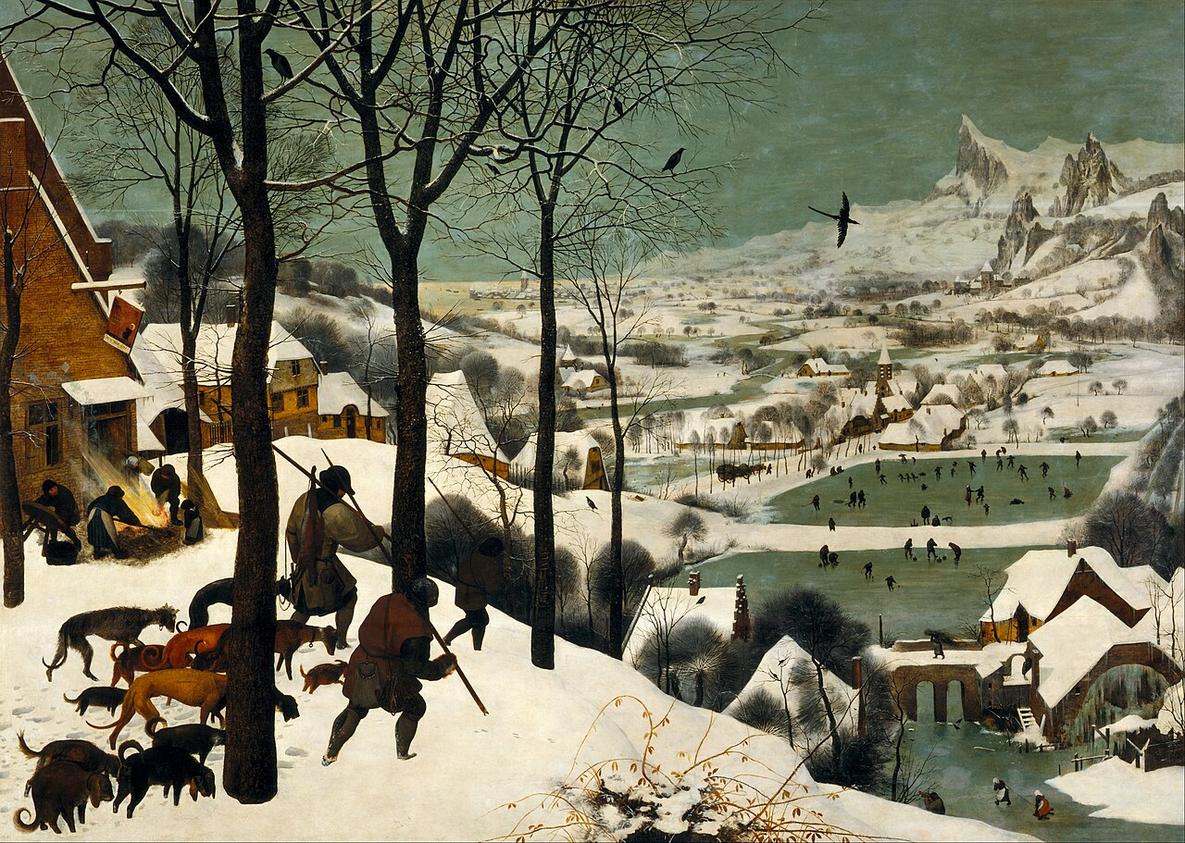
That choice mattered. Peasants were rarely the main subject of large paintings in his time. Bruegel showed them without turning every scene into a joke or a sermon. Look at his crowded compositions and you find people absorbed in their own tasks, often unaware of the larger story unfolding around them. The world does not pause just because a viewer is looking.
His landscapes work in a similar way. They invite you to scan from nearby figures toward distant fields, buildings, and hills. You are not handed one hero to follow. You have to decide where to look—and then notice how much is happening outside your first choice.
Standing beside the working painter
Imagine standing near Bruegel in Antwerp, where he spent years making designs for a major print publisher. You would not be watching a solitary master produce every part of a finished print. You would be near a working network: a designer making an image that other specialists would translate into a reproducible object for buyers.
That practical setting fits the drawing’s title. A painter and a buyer are not opposites in Bruegel’s world; they are part of the same exchange. We cannot identify the figures in the image with certainty from its title alone, or assume that the painter shown is Bruegel himself. The uncertainty is worth keeping. It leaves us with the real question the scene raises: who gets to judge what an artist makes, and what does the artist notice that the buyer might miss?
Look again, then choose your detail
Bruegel’s pictures reward more than a quick glance. Give your eyes time to wander. Start with the people nearest you, then follow the landscape outward. Notice how an ordinary action can hold its ground beside a grand religious or historical subject.
You do not need a specialist’s vocabulary to meet his work. You need a little time, and the willingness to look beyond the obvious. Bruegel understood that a whole world could fit inside an ordinary day.
Works by Pieter Bruegel the Elder on the wall