
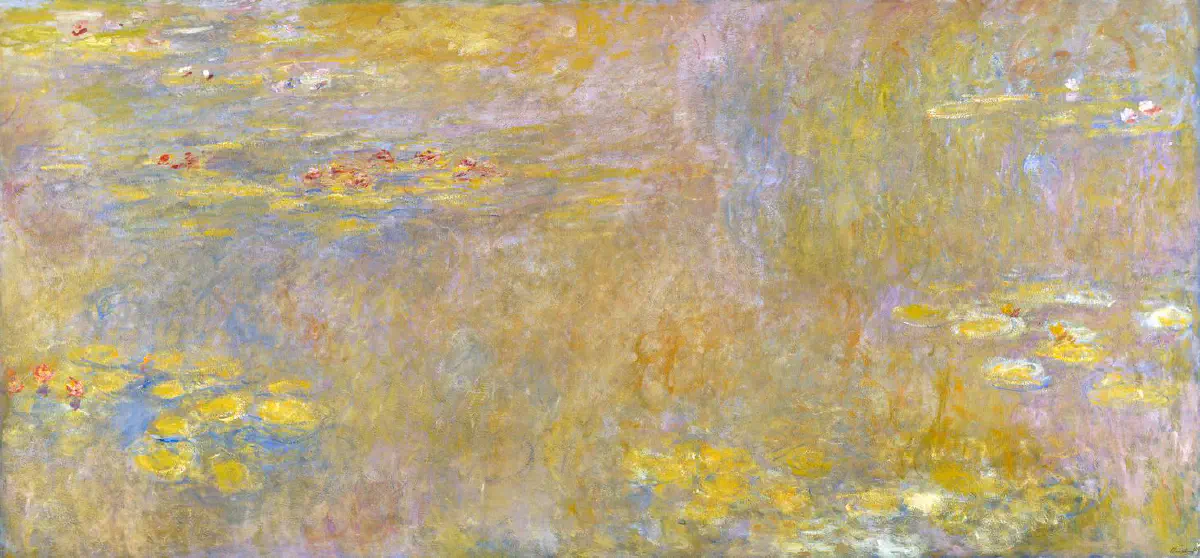
Water Lilies
Claude Monet, 1916, National Gallery, London Public Domain · SourceStop calling it a peaceful pond. Monet has removed the shore and horizon, so you cannot stand safely outside this scene and look in. The water fills the picture. You are already caught in it.
Visual grammar: how the painting works
1. Frame and viewpoint
There is no bank, sky, or distant landmark to tell you where you are. Monet crops the pond until it becomes the whole world of the picture. Your eye cannot settle into a conventional landscape view; it has to move across the surface instead.
2. Figure and ground
The lily pads are the clearest objects, but they do not stay neatly separate from the reflections around them. Look at how dark, light, and coloured marks keep changing roles: a patch can read as water, reflected light, or paint before your eye decides. That uncertainty is not a mistake to solve. It is the subject’s engine.
3. Direction and movement
The horizontal canvas encourages a side-to-side scan. The pads interrupt that sweep, while the loose, shifting marks pull your gaze through the spaces between them. No single flower gets promoted to “the main event.” Your eyes do the travelling.
4. Colour and contrast
Instead of drawing every leaf with a firm outline, Monet lets contrasts do much of the separating. The image asks you to read relationships—light against dark, one colour beside another—rather than hunt for a crisp botanical diagram. The pond looks reflected and painted at the same time.
5. The point people miss
This is not simply a test of whether Monet could copy a garden. His water-lily paintings grew into a long project: he made more than 250, and the motif became a starting point for increasingly fluid, near-abstract painting. The familiar subject is real; the unstable surface is the argument.
Monet lived and worked at Giverny, where he built a garden that included a water-lily pond. He returned to the lilies for roughly the last two decades of his life. In later years cataracts affected his colour vision; that context matters, but it does not turn every loose mark into a symptom or make the painting an accident. Look first at what the picture actually does: it makes reflection hard to separate from the painted surface.
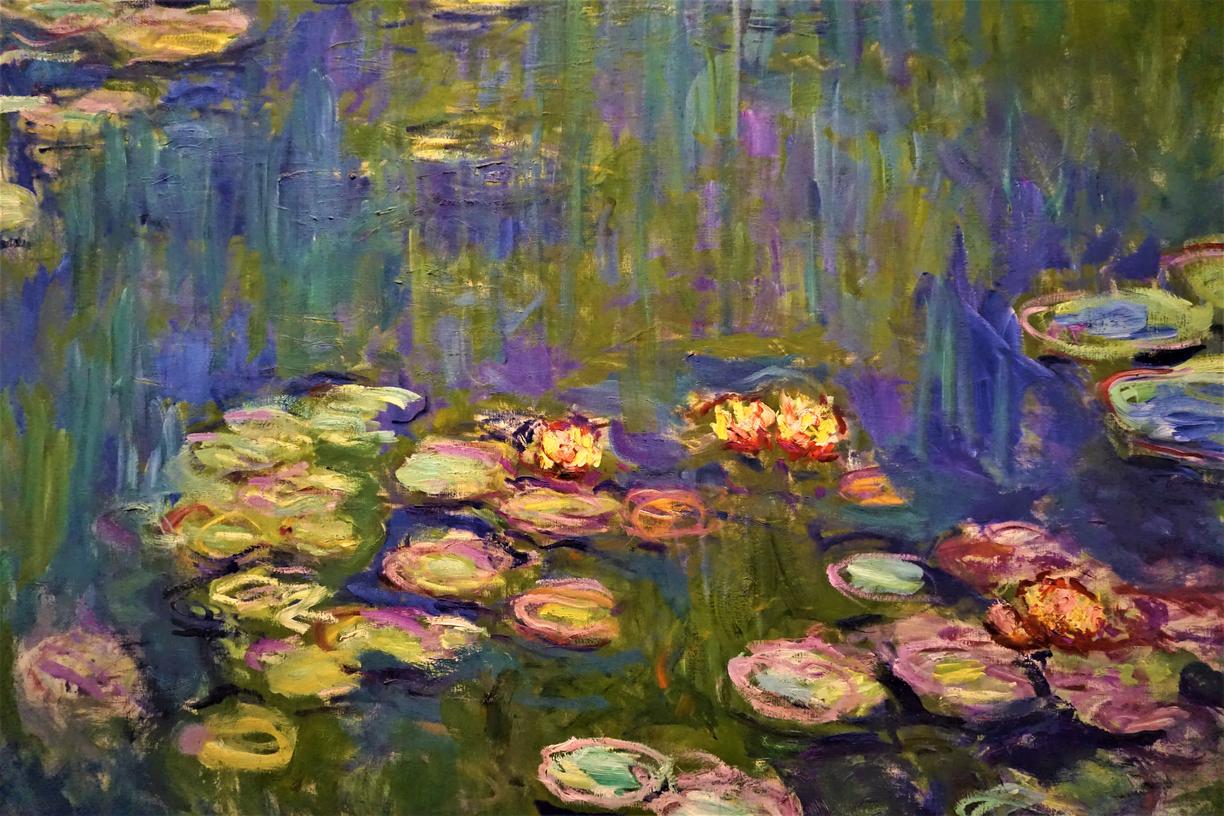
Try this in the gallery: stop naming the flowers for ten seconds. Follow the reflections instead. The painting gets less like a garden postcard and more like a surface you have to read.
The comparison image above shows a different Water Lilies canvas in Tokyo; it is not a detail of the National Gallery painting.