
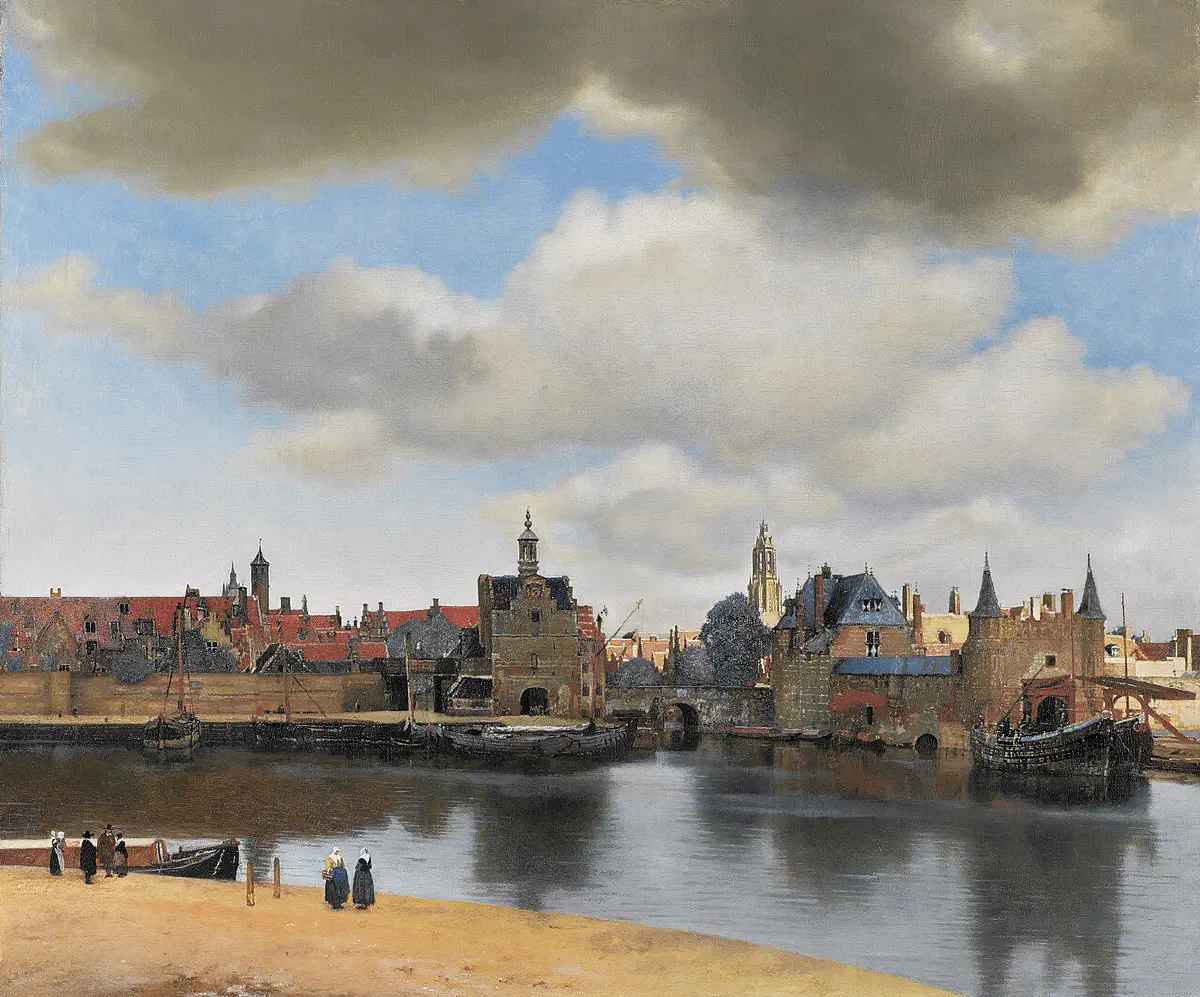
View of Delft
Johannes Vermeer, 1660–1661, Oil on canvas, Mauritshuis, The Hague Public Domain · SourceView of Delft: Vermeer’s City in a Patch of Sunlight
A cityscape can be a dull inventory of buildings. Vermeer gives Delft a sky, a harbour, and a little human traffic—and suddenly you are not looking at a map. You are standing across the water, waiting for a boat while the weather decides what the city will look like.
Start with the light, then find the town
The broad, cloud-filled sky takes up a large share of the canvas. Sunlight picks out parts of the brick buildings while other sections stay in shadow. The water below catches the same city in broken reflections. Let your eye travel from those bright patches down to the dark harbour: Vermeer has made the light feel like an event, not decoration.
This is Delft, Vermeer’s hometown, viewed from an elevated position to its southeast. The exact spot is uncertain; one suggestion is the upper floor of the Mechelen tavern. Across the water, the Rotterdam Gate stands at the far right and the Schiedam Gate sits nearer the middle. Behind the buildings, the lit spire of the Nieuwe Kerk rises into the sky. Vermeer shifted that tower closer to the centre than its real position, giving it extra prominence.
There is a detail worth carrying with you: the Nieuwe Kerk’s tower has no bells. They were added after Vermeer painted the scene, in 1661. The painting is not a frozen photograph of Delft; it is a carefully arranged view of a place that was still changing.
A quiet harbour, not an empty one
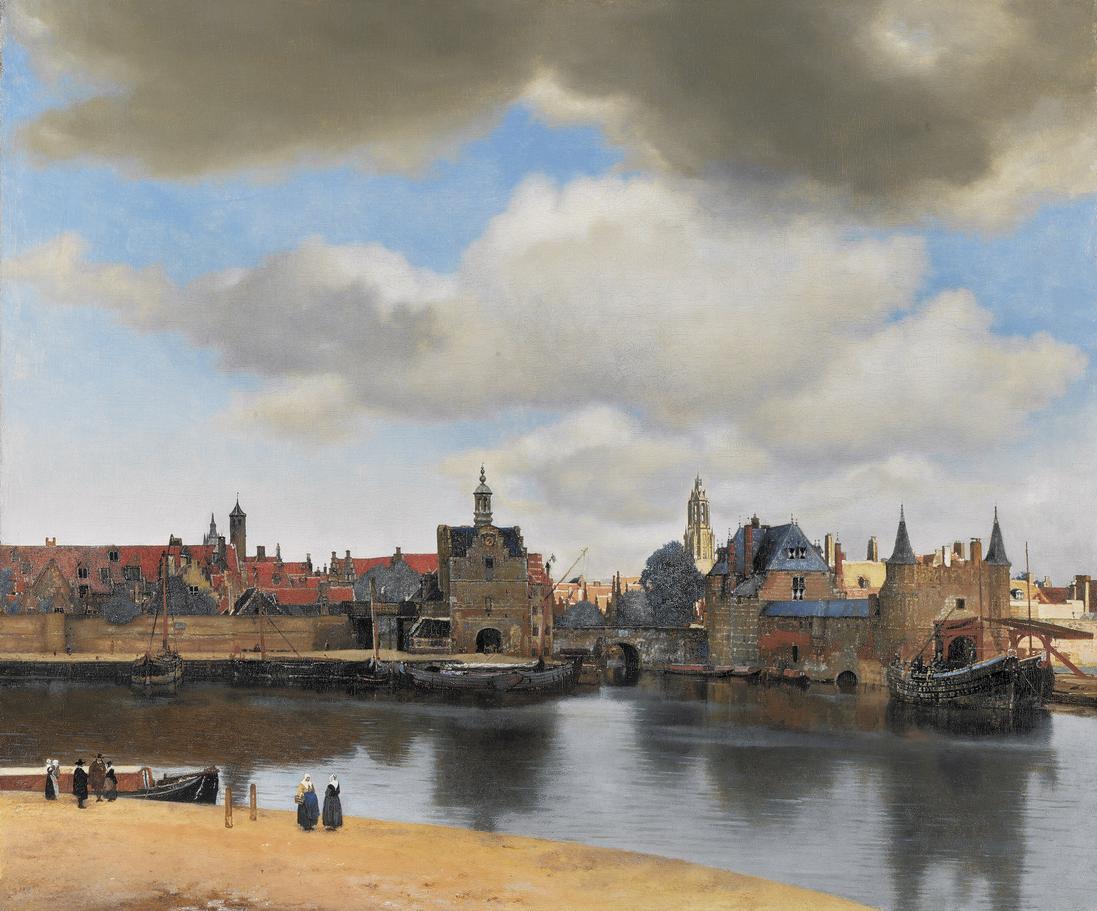
The harbour looks calm, but the foreground is busy with ordinary decisions. At lower left, five people wait to board a passenger barge. It could take them toward Rotterdam, Schiedam or Delfshaven, and a horse pulled it along. Vermeer even left his initials, “VM,” on the red interior of the boat. Near it, two women talk. A third figure once stood beside them; Vermeer painted that person out.
That small edit is a useful reminder: this apparently effortless view was made through choices, revisions and omissions. Vermeer did not simply copy everything in front of him. He arranged the scene until its few people and boats gave the wide city a human scale.
The quiet water also does careful work. It reflects the buildings without turning the harbour into a mirror-perfect diagram. Look for the broken bands of colour, then compare them with the walls and roofs above. Vermeer used pigments including natural ultramarine, lead white, yellow ochre, madder lake and calcite. The calm effect came from a painter handling materials and light with precision—not from magic.
What is certain, and what is not
Art historians have debated whether Vermeer used a camera obscura, an optical device that could project an image through a lens. The soft highlights in the buildings and water have been cited as clues, but there is no documentary proof that he used one, and scholars disagree. You do not need to settle that argument to see what the painting does: the light is observed closely, then shaped into a composition.
The picture was made around 1659–1661 and has been in the Mauritshuis in The Hague since the museum’s establishment in 1822. Its first known owner was Pieter Claesz van Ruijven, a Delft collector who also owned Vermeer’s The Little Street. The suggestion that he commissioned View of Delft is plausible, but not certain.
So when you look again, try this: pick one sunlit wall, follow its reflection down into the water, and then find the tiny people waiting to travel. That is Vermeer’s scale in a nutshell—the city, the weather and a few lives all sharing the same patch of light.
Artwork: Johannes Vermeer, View of Delft (Gezicht op Delft), c. 1659–1661. Oil on canvas, 96.5 × 115.7 cm. Mauritshuis, The Hague. Image: Wikimedia Commons, public domain. Historical details: Wikipedia, “View of Delft”.