
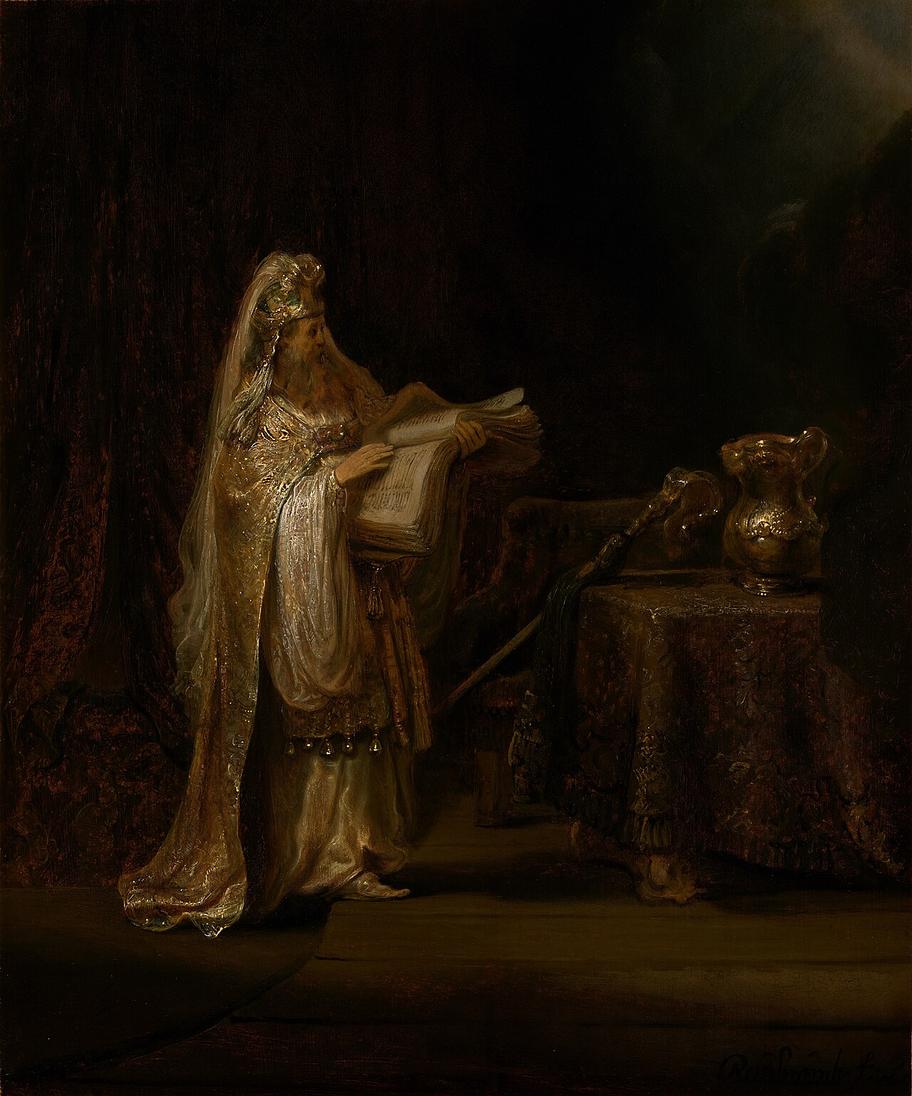
The Vision of Zechariah in the Temple
Rembrandt van Rijn, 1633, Oil on panel, Rijksmuseum, Amsterdam (on long-term loan from a private collection) Public Domain · SourceThe Vision of Zechariah in the Temple: Rembrandt’s Small Scene of a Life-Changing Message
A beam of light enters from the upper right. An elderly priest stands beside a table, dressed for an important temple service. He does not look like a man who has just received astonishing news. That pause is the point.
In The Vision of Zechariah in the Temple, Rembrandt paints the moment when the angel Gabriel tells Zechariah that he and his wife Elizabeth will have a son, John the Baptist. The Gospel of Luke says the couple were old and had no children. Zechariah doubts the announcement, and Gabriel tells him he will be unable to speak until the child is born. This is not a grand scene of crowds and spectacle. It is one person trying to take in news that changes the rest of his life.
Look for the small but forceful clue in the upper right: the light signals Gabriel’s arrival. The angel is not shown as a fully described figure. Instead, Rembrandt lets light do the announcing. That choice keeps your attention on Zechariah—on the human response, not on a supernatural visitor taking over the picture.
The painting also has a story outside the frame. Made in 1633, it had been included in Rembrandt catalogues before doubts led to its removal from the accepted group in 1960. After it was sold to a private collector in 1961, it was out of public view. In 2026, Rijksmuseum researchers reassessed it following a two-year study. Their comparison with Rembrandt’s work from the same period, along with analysis of materials, style, and changes made during painting, led them to attribute it to Rembrandt again. It is now on long-term loan to the Rijksmuseum.
That is a useful reminder: an artist’s name on a museum label is not a timeless fact carved in stone. Experts study the object, compare evidence, and sometimes change their minds. Here, the painting’s story includes both a quiet biblical encounter and a very modern question: who made it?
Rembrandt was 27 in 1633. He was working in the Dutch Republic during the period often called the Dutch Golden Age, and was already developing the dramatic use of light and shadow for which he is known. But there is no need to treat the painting as a puzzle reserved for specialists. Start with the light, then look at the priest. The scene asks you to notice what happens between receiving a message and believing it.
When you look at Zechariah, do you read his stillness as doubt, surprise, or concentration?