
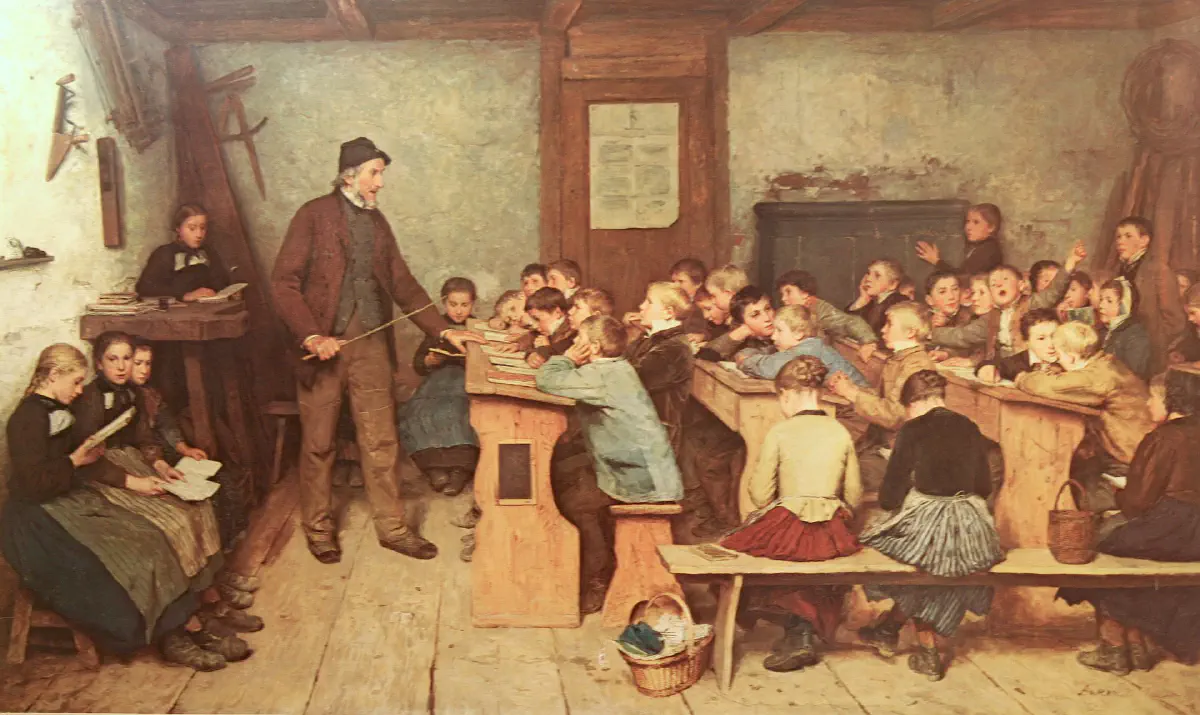
The Village School of 1848
Albert Anker, 1895–1896, Oil on canvas, Kunsthaus Zürich, Zürich Public Domain · SourceOne room, every age
One teacher, one room, and every child in the village: the six-year-old beside the nearly grown-up, the alphabet next to the copybook. Albert Anker painted that scene in 1895 and 1896, and the title points backwards: Die Dorfschule von 1848, the village school of the year 1848, when the young Swiss federal state received its constitution and set about building the schools to go with it.
The picture is not a memory of 1848. It was commissioned as an illustration for Jeremias Gotthelf’s novel Leiden und Freuden eines Schulmeisters, The Sorrows and Joys of a Schoolmaster, first published in 1838, and Anker knew his Gotthelf: among his hundreds of commissioned drawings and watercolours was work for an edition of the collected works. For the composition he reached back to his own Dorfschule im Schwarzwald of 1858. That early canvas, which debuted at the Paris Salon of 1859 and sold to a Glasgow collector for 1,500 francs, shows the old school: a teacher with a stick under his arm spreading fear and terror, three boys hauled up before his desk, a barefoot girl weeping into a handkerchief, the girls pushed to the edge with their knitting. The Kunstmuseum Bern’s guide calls it an old-fashioned idea of school, all gloom and stifling crowding. The 1896 painting keeps the subject and asks what the room looks like after forty years of school reform.
Look at the desks first
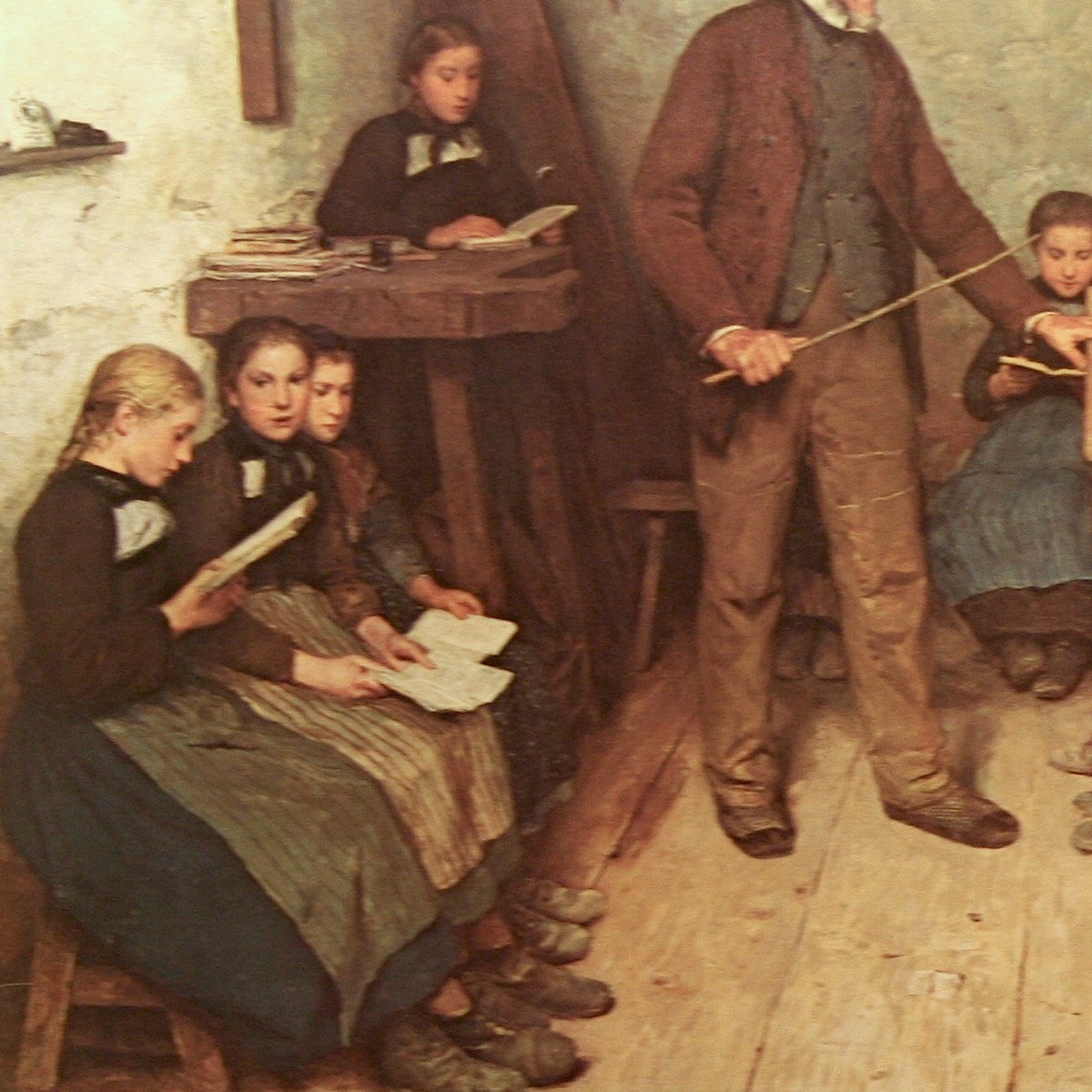
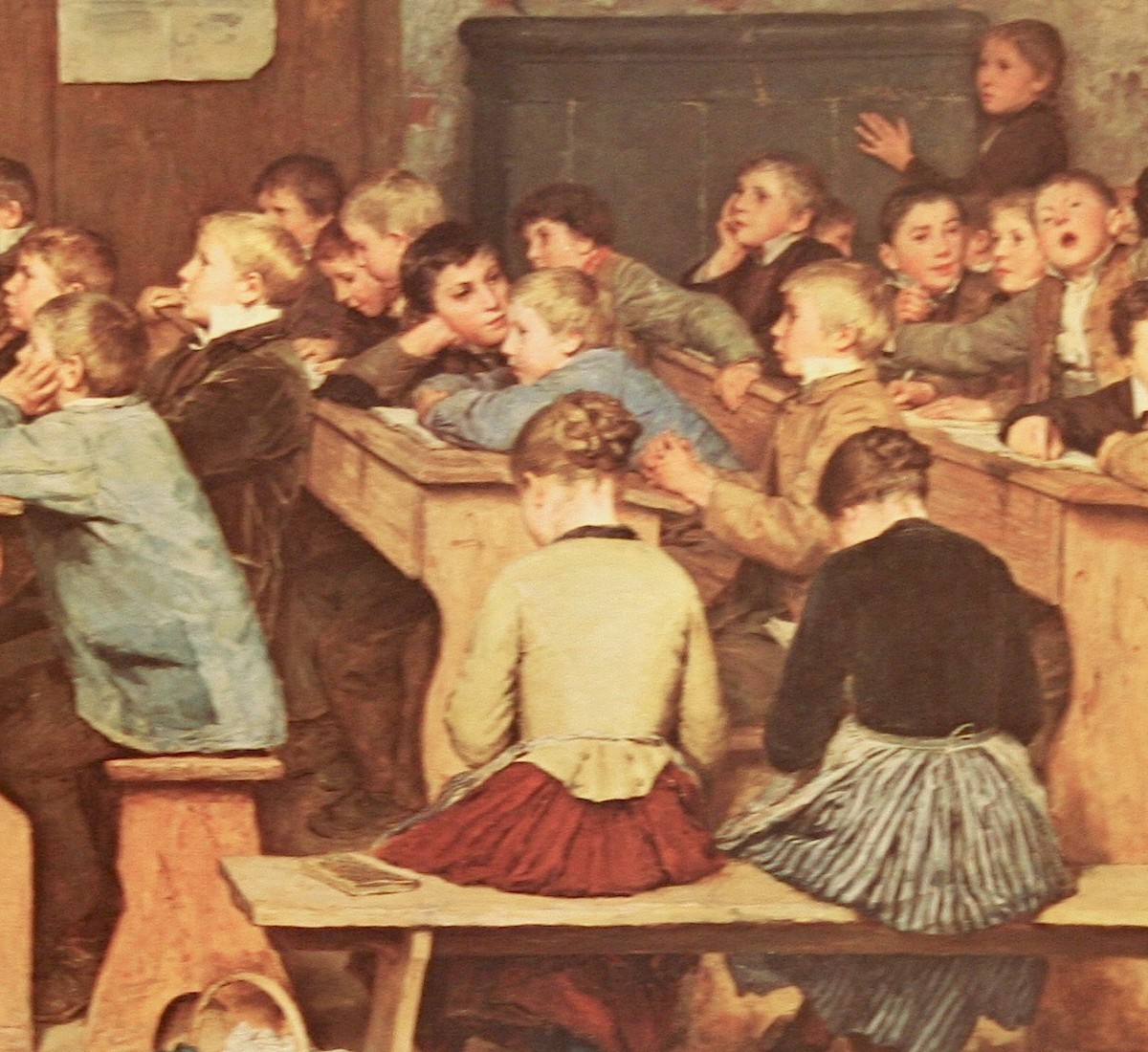
The teacher sits at his raised desk on the left, the whole class assembled in front of him on long benches. Boys and girls share the room. Some read, some write, and the ages run from small to nearly grown, the one-room school the title promises. Light falls from a window on the right and travels down the rows, finding pale faces and white collars out of the dark clothing. Nothing is dramatised. Anker depicts his fellow citizens in the “unpretentious and plain manner” that made him Switzerland’s most popular genre painter, so identified with rural life that he is still called its national painter.
The picture in our heads
An essay on Anker’s school pictures carries the title “Wie es war und nie gewesen ist”: how it was, and never was. The same essay observes that images did more than anything else to shape ideas of what 19th-century schooling looked like, and that this painting stands at the head of them; it also notes how little interpretive commentary the picture has received. Its authority is borrowed twice over: commissioned for a novel, modelled on an older and darker canvas, it became the schoolroom the country keeps in its head. In 2026, after long years as a deposit in the public art collection of Basel, the painting entered the Kunsthaus Zürich, acquired for the collection by the Vereinigung Zürcher Kunstfreunde. A village school picture arrives in the city and keeps doing its quiet work. It tells us what school was like. Keep the second half of the essay’s title in mind while you look.
Sources
- Wikipedia, Albert Anker (accessed 23 November 2026): en.wikipedia.org/wiki/Albert_Anker
- Hanspeter Kellerhals, “Ankers Schule von innen und aussen: Wie es war und nie gewesen ist”, Berner Zeitschrift für Geschichte 72/2 (2010): bezg.ch/img/publikation/10_2/kellerhals.pdf
- Gotthelf-Edition, Universität Bern, Leiden und Freuden eines Schulmeisters: gotthelf.unibe.ch
- Kunsthaus Zürich, collection sheet for Die Dorfschule von 1848, inventory VZK.2026/0007: collection.kunsthaus.ch
- Kunstmuseum Bern, Digital Guide, Dorfschule im Schwarzwald (1858): guide.kunstmuseumbern.ch
- Image: Albert Anker, Die Dorfschule von 1848 (The Village School of 1848), 1895/96, Kunsthaus Zürich. Wikimedia Commons, File:Anker Die Dorfschule von 1848 1896.jpg; public domain (PD-old-100-expired).
