
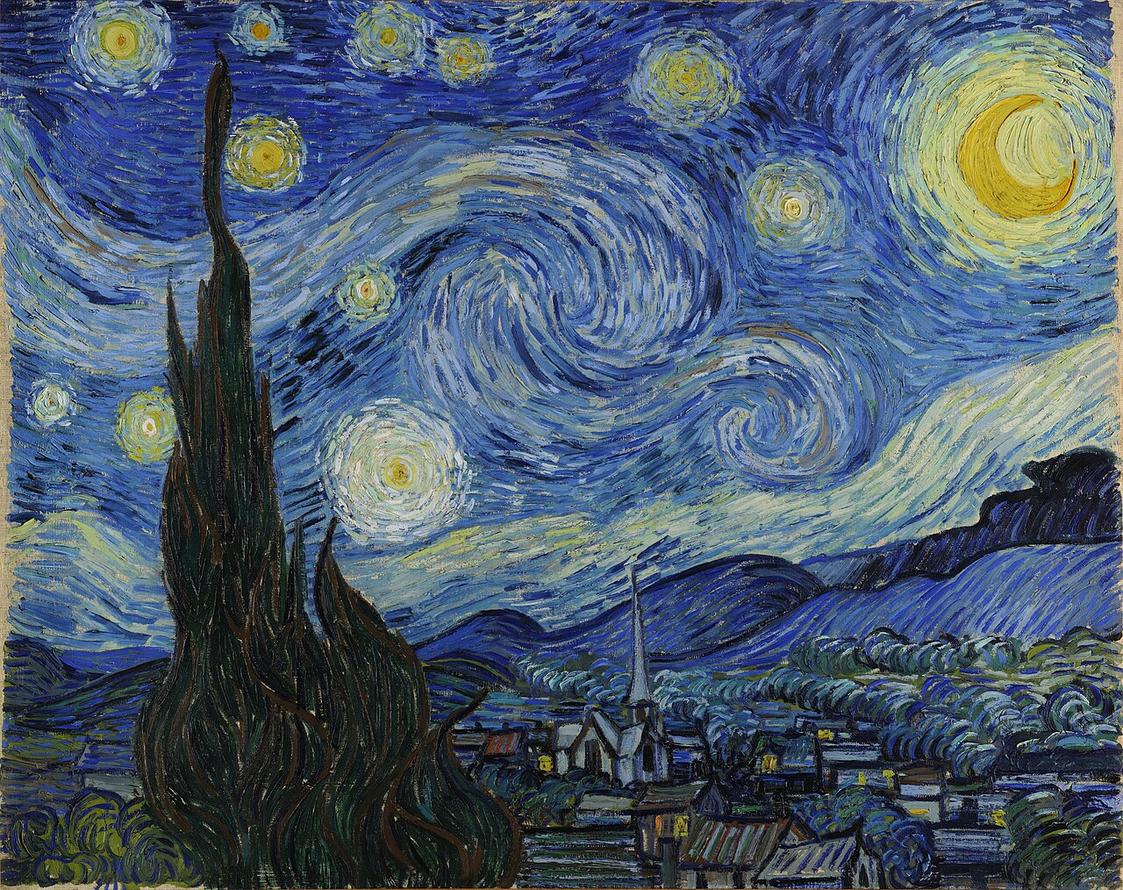
The Starry Night
Vincent van Gogh, 1889, Oil on canvas, Museum of Modern Art, New York Public Domain · SourceThe Starry Night: A View from a Room, Not a Dream
You have probably seen this sky on a poster, a mug, or a museum wall. The useful surprise is that The Starry Night did not begin as pure fantasy. Vincent van Gogh painted it in June 1889, drawing on the view from the east-facing window of his room at the Saint-Paul-de-Mausole asylum near Saint-Rémy-de-Provence. He painted the scene in his studio, and he changed what he saw.
Start at the bottom. The village looks settled and sleepy, with a church steeple pointing into the sky. But it was not visible from that bedroom window: Van Gogh added it, building on a sketch. So this is not a faithful snapshot. It is a real landscape rearranged by a painter who wanted the scene to hold together on canvas.
Now follow the cypress. It rises from the foreground like a dark flame and cuts across the sky’s wide curves. Van Gogh enlarged the tree, bringing it close to us. People often assign cypresses a grand symbol—death, eternity, the whole dramatic package. The evidence is less tidy. Van Gogh wrote about the trees as subjects he wanted to paint, and the question of whether he meant this one as a symbol remains open. You do not need a secret code to notice what it does: it connects the ground to the sky and makes the landscape feel suddenly close.
That bright point just to the right of the cypress is Venus. It was visible in the morning sky in Provence in spring 1889. The Moon, by contrast, is stylized rather than an accurate record of its astronomical phase. Van Gogh gives the stars and moon yellow halos, set against blues made with ultramarine and cobalt. The yellow pigments identified in the stars and moon include Indian yellow and zinc yellow.
Here is the awkward fact that makes the picture more interesting: Van Gogh was not fully pleased with it. In a letter to his brother Theo, he dismissed some of the paintings he had sent as saying little to him; later, he called The Starry Night a “failure.” That does not settle what the painting means. It does remind us that the artist did not paint with a future crowd of admirers looking over his shoulder.
The painting moved through several owners before the Museum of Modern Art acquired it in 1941. Today, its familiar sky can make it seem like a picture you already know. Take another look anyway. Notice how the village stays still while the sky seems to move, and how the cypress refuses to let you keep the two apart. What do you notice first: the quiet village, the bright Venus, or the restless sky?
The Starry Night, 1889. Oil on canvas. Museum of Modern Art, New York. Public domain image via Wikimedia Commons.