
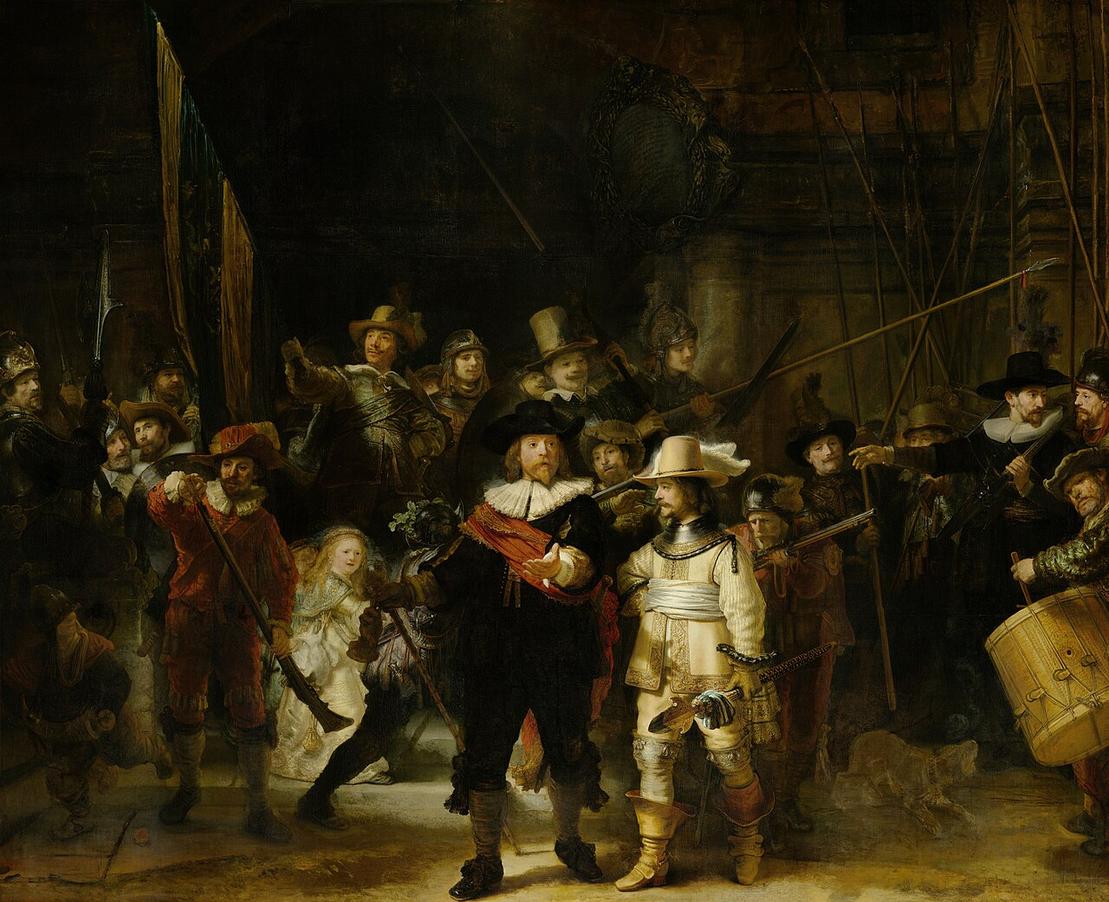
The Night Watch
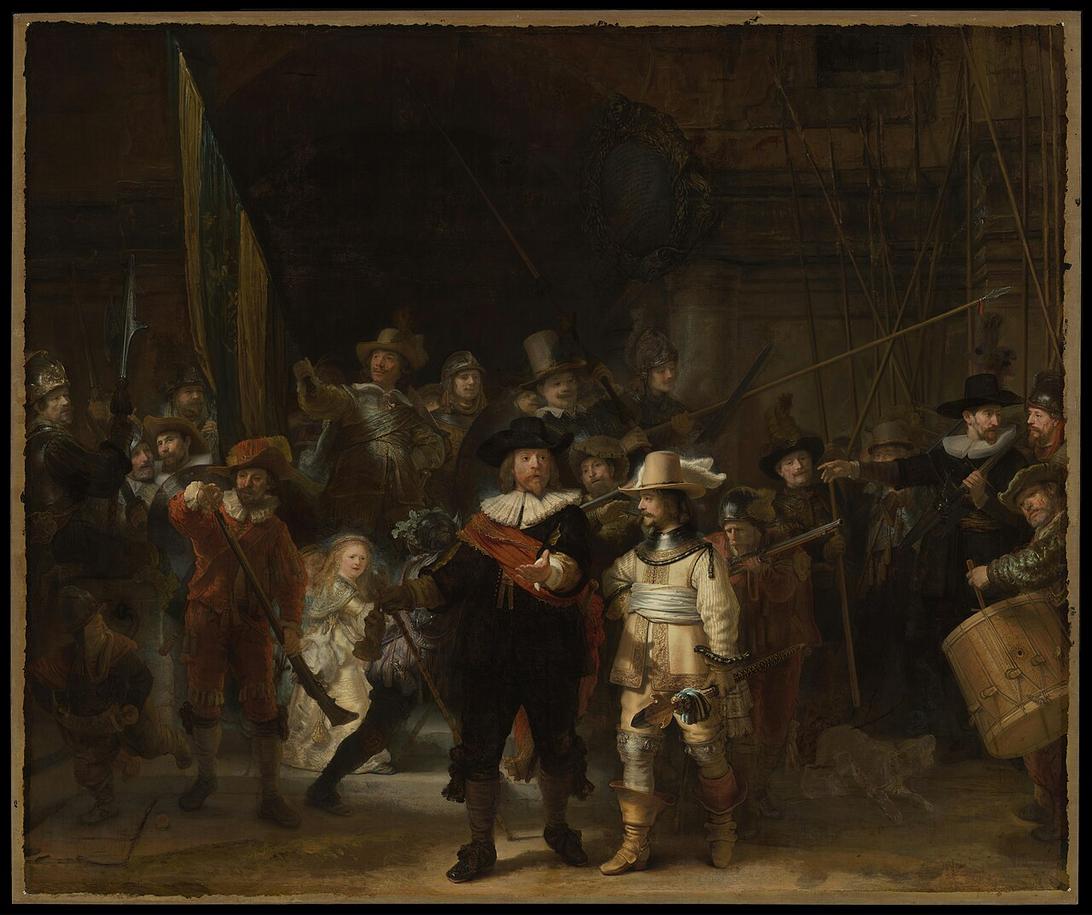
Rembrandt van Rijn, 1642, Oil on canvas, Rijksmuseum, Amsterdam Public Domain · SourceThe title sets a trap. The Night Watch does not show a night watch, and it is not really a portrait of people standing still. Rembrandt’s 1642 canvas shows an Amsterdam civic militia company setting off, with Captain Frans Banninck Cocq in black and a red sash, and his lieutenant Willem van Ruytenburch in bright yellow. The darkness that suggested night came from an old varnish, removed in the 1940s. The familiar title stayed.
Look at the two leaders first. Cocq’s hand reaches forward, while the lieutenant steps into the light beside him. Around them, the company is not arranged in a neat row for a roll call: people turn, move, handle weapons and respond to the activity around them. Rembrandt took a group portrait—a commission meant to represent named members of a militia—and made it feel as if you have arrived just as the group is getting under way.
The bright little figure behind the leaders is easy to mistake for decoration. She carries a dead chicken at her belt, an emblem associated with the arquebusiers, the militia group’s traditional identity. This is not a quiet symbol tucked away for specialists: it is one of the painting’s sharpest visual clues about who these men are.
The commission came around 1639 from Cocq and seventeen members of the company. A shield painted into the background around 1715 lists eighteen names; the drummer was added to the painting without charge. The canvas contains 34 figures in all. Rembrandt was paid 1,600 guilders, with each of the named members contributing 100. So the picture’s lively crowd was also a paid group commission—not an artist working in splendid isolation.
There is another surprise: the picture now on view is smaller than Rembrandt’s original. In 1715, it was trimmed on all four sides to fit a new location at Amsterdam’s town hall. Two figures on the left and parts of the architecture and foreground were lost. A 17th-century copy by Gerrit Lundens preserves a view of the original composition. The present-day canvas is therefore not quite the scene Rembrandt planned; the missing edges changed its balance and made the central figures seem more dominant.
The work was commissioned for the meeting hall of Amsterdam’s civic guards and is now prominently displayed at the Rijksmuseum, though it belongs to the Amsterdam Museum’s collection. That history matters. This is not a timeless parade of heroes. It is a public image made for a particular civic group, with its members’ names, emblems and money built into the story. Rembrandt’s achievement was to make that practical job refuse to stand still.
Next time you see it, try not to begin by counting the figures. Follow the captain’s hand, then the lieutenant’s bright sleeve, and notice how the crowd seems to gather around their movement. The picture’s famous drama is not a battle or a night scene. It is the simple, vivid feeling that everyone is about to go somewhere.