
The Gleaners
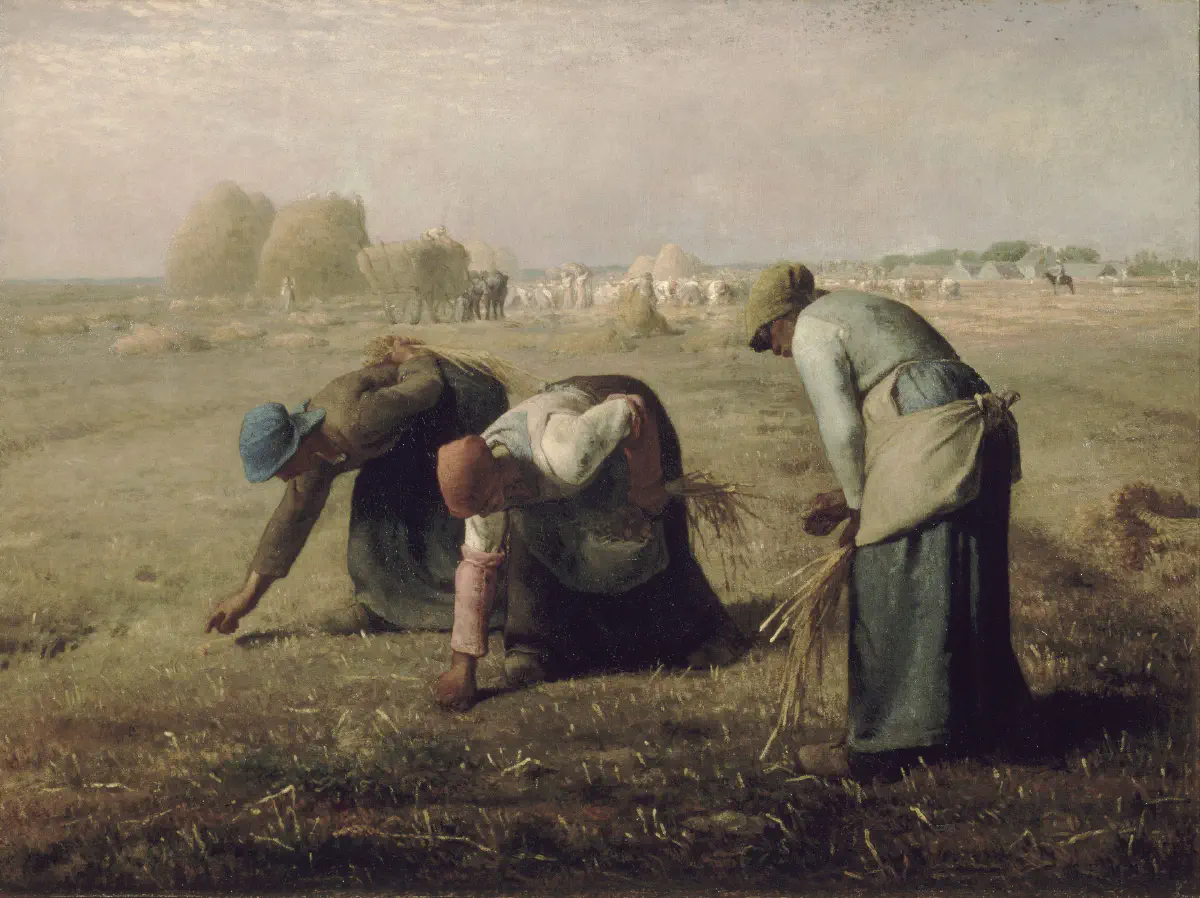
Jean-François Millet, 1857, Oil on canvas, Musée d'Orsay, Paris Public Domain · SourceWhat the Harvest Leaves Behind
Three women bend over a stubble field. That is the whole subject: three women, a field, and what the harvest left behind. When Jean-François Millet showed The Gleaners at the Salon of 1857, the reaction in Paris had little to do with wheat. One critic spoke for the prosperous part of the audience when he saw in the picture an alarming reminder of “the scaffolds of 1793”, the guillotine of the Revolution, four decades old and not forgotten.
They were overreacting, and they were right in a way they did not intend. The painting demands nothing. It is simply honest about who picks up what the harvest leaves. Gleaning meant walking the cut field after the carts had gone, gathering stray stalks one by one for bread. What unsettled the Salon was how Millet showed it: a canvas of 84 by 112 centimetres, a size reserved for religious and mythological subjects, with three labourers in the place of gods. Another critic found them posing as the “Three Fates of Poverty”, their ugliness unrelieved.
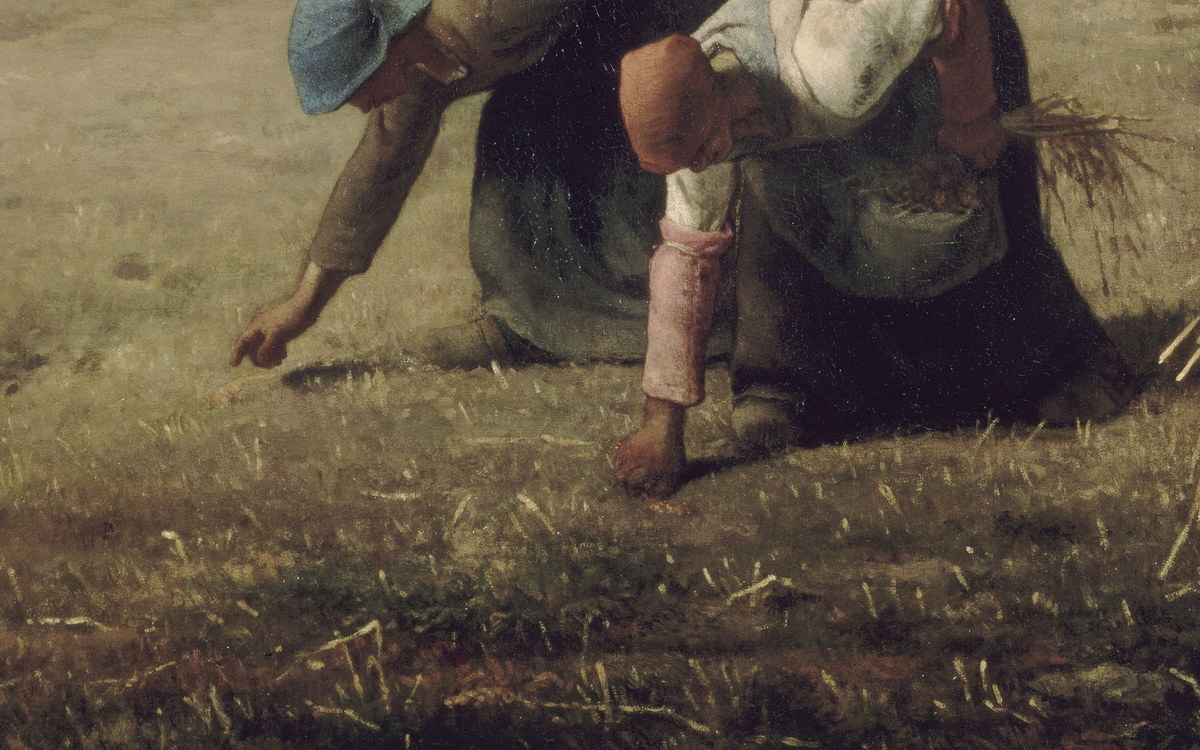
Look at the ground first
The three women stand close together in the lower part of the canvas, and Millet separates them by gesture rather than by story. The one on the left bends deep into the stubble. The middle one half rises, her hand pressed to her back. The third reaches forward to pick a single stalk. Repeat the motion three times and you have the rhythm of their whole afternoon.
Then lift your eyes, because the painting does. Behind the women the field opens into a golden distance: loaded carts, haystacks, a crowd of harvesters, a village on the horizon. All the abundance stays far away, in warm light the women do not share. The foreground is muted and cool among the cut stubble. The composition makes the argument on its own: the distance between the gleaners and the harvest is the distance between poverty and plenty, and Millet has built it into the perspective itself.
What the picture cost
The Salon crowd read class conflict into the picture, and the market later priced it the same way. Millet, short of money after the exhibition, sold it for 3,000 francs against an asking price of 4,000 and tried to keep the low figure secret. In 1889 it sold for 300,000 francs, and in 1891 the will of Madame Pommery sent it to the Louvre. It now hangs in the Musée d’Orsay. An image of the poorest kind of work had become one of the most expensive paintings of rural life in France.
Younger painters took the lesson differently. Pissarro, Renoir, Seurat and van Gogh all paraphrased its image of bent labourers, and Robert Rosenblum called the painting an epic hymn to labour that later pictures of workers are hard to imagine without.
The backs we look at
Notice one thing you are never given: a face. The women work with their backs and shoulders to us, absorbed in the ground in front of them. We study them; they do not perform for us. Stand in front of the canvas and your eye keeps travelling from their bent backs to the bright harvest behind, then back again, along the route the painting wants. It does not tell you what to feel about that journey. It just makes sure you take it.
Sources
- Wikipedia, The Gleaners (accessed 16 November 2026): en.wikipedia.org/wiki/The_Gleaners
- Image: Jean-François Millet, Des glaneuses (The Gleaners), 1857, Musée d’Orsay, Paris. Wikimedia Commons, File:Jean-François Millet - Gleaners - Google Art Project.jpg; public domain.
