
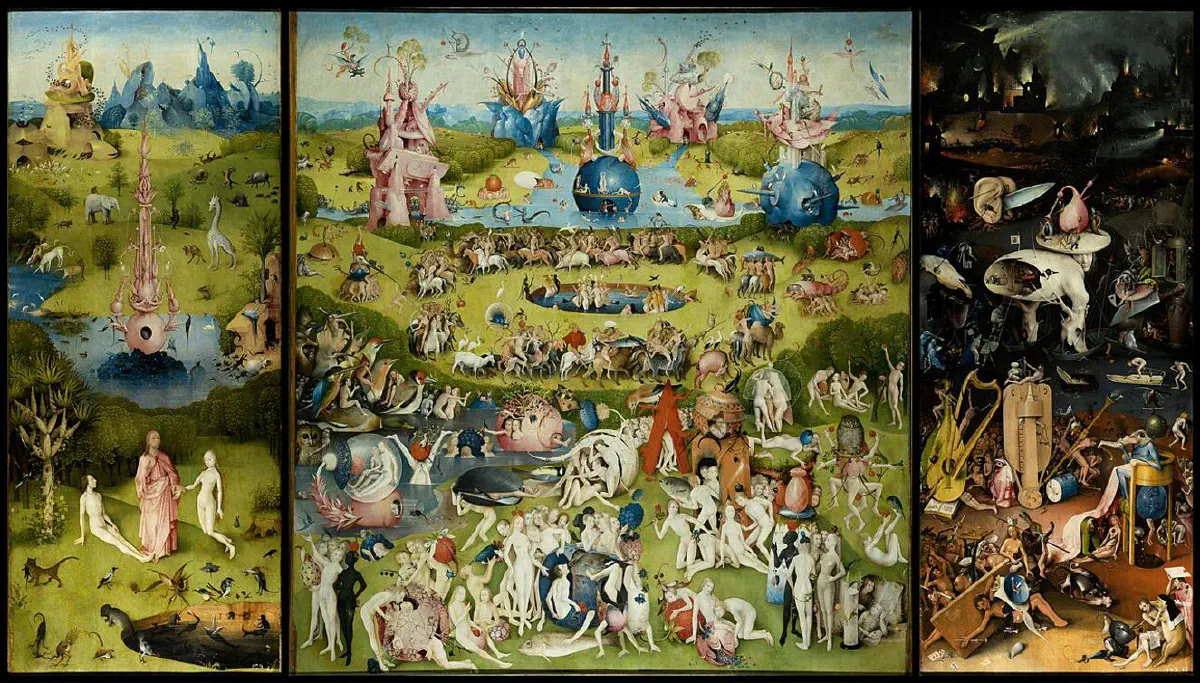
The Garden of Earthly Delights
Hieronymus Bosch, 1490–1510, Oil on oak panels, Museo del Prado, Madrid Public Domain · SourceA triptych with three very different weekend plans
Start at the left: God presents Eve to Adam in a landscape full of unfamiliar animals. Move to the center, and the rules seem to disappear. Nude people play among oversized fruit and strange creatures. Then look right. The pleasure garden has become Hell, where people face punishments among fires, demons, and oversized musical instruments.
That is the basic route through Hieronymus Bosch’s The Garden of Earthly Delights: Eden, earthly pleasures, and Hell. The painting is a triptych—three connected panels—and the scenes are generally read from left to right. Bosch gives you no quiet pause between them. One moment you are looking at a strawberry; the next, at the consequences of a life without limits.
The familiar title is modern. The painting itself was made sometime between 1490 and 1510, though the exact date is uncertain. It is now in Madrid’s Museo del Prado.
Look closer: one fruit gets a starring role
The center panel is packed with tiny scenes. People gather, ride animals, enter shells, and explore enormous fruits. The scale keeps slipping: a fruit can dwarf a person, and ordinary logic seems to have taken the afternoon off.
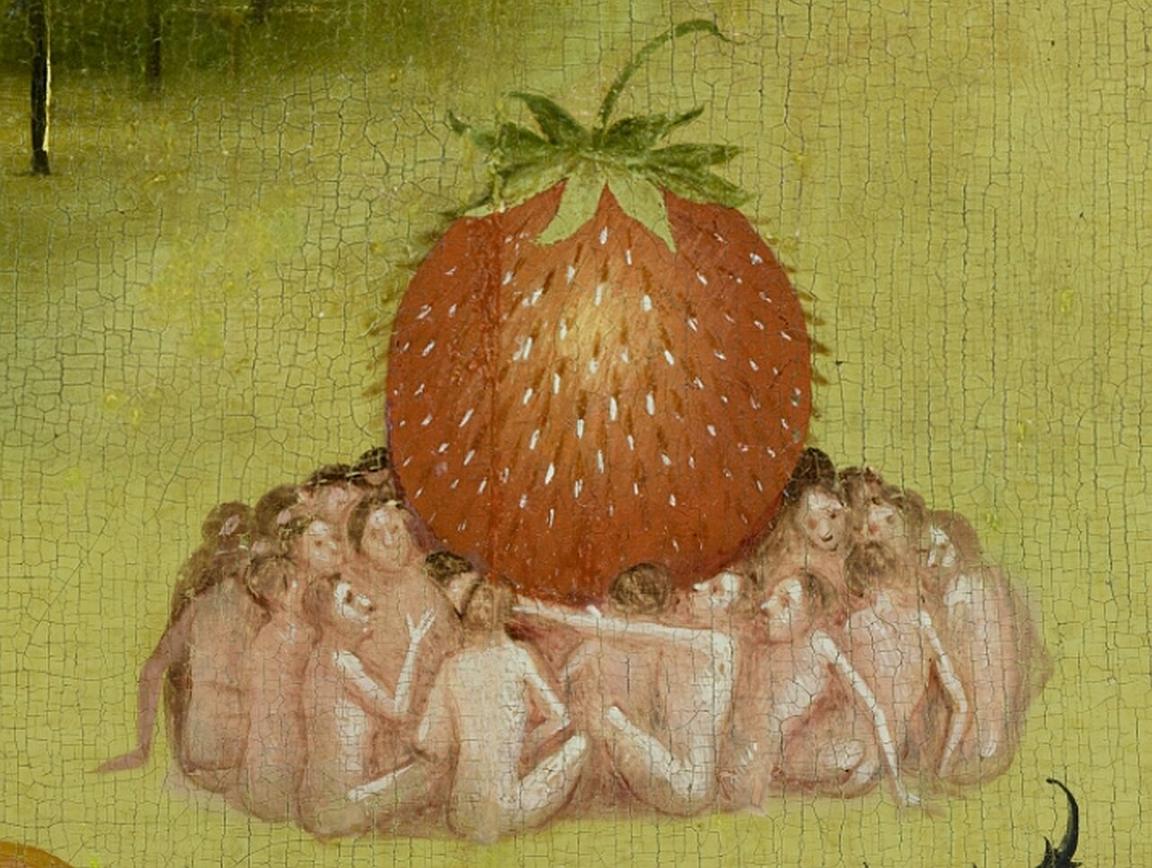
Try this in the gallery: choose one small group and follow it for a few seconds. The panel is not one neat story with a single main character. It is a crowd of separate episodes, all competing for your attention. Bosch makes looking feel less like reading a caption and more like scanning a room where several conversations are happening at once.
Is the garden a warning—or something stranger?
A common reading treats the central panel as a warning about temptation and the short life of worldly pleasure. In that view, the scenes lead toward the punishment shown on the right. But scholars have not agreed on a single explanation. Some have read the center as a picture of humanity before the Fall; others have proposed very different meanings. The painting’s symbolism is so dense that confident claims about every creature or gesture can outrun the evidence.
That uncertainty is part of the point. Bosch gives us a clear structure—creation, a world of pleasures, and Hell—then fills the middle with scenes that refuse to behave like a simple moral diagram. The garden looks inviting, but its inhabitants seem unaware of what comes next. Whether you see innocence, temptation, or something more complicated, the ending is hard to ignore.
The triptych was documented in 1517 in the palace of the Counts of Nassau in Brussels. It later entered the collection of Philip II of Spain and was at El Escorial before moving to the Prado in 1939. This was not an obscure private puzzle hidden from everyone: its early setting was a prominent palace, and visitors could see it.
Bosch’s biography remains thinly documented, and no note survives explaining exactly what he intended here. So resist anyone who tells you that one tiny animal unlocks the whole painting. Look at the left-to-right journey, pick a detail, and decide what changes when the garden gives way to Hell. What caught your eye first: the fruit, the creatures, or the sudden turn toward punishment?