
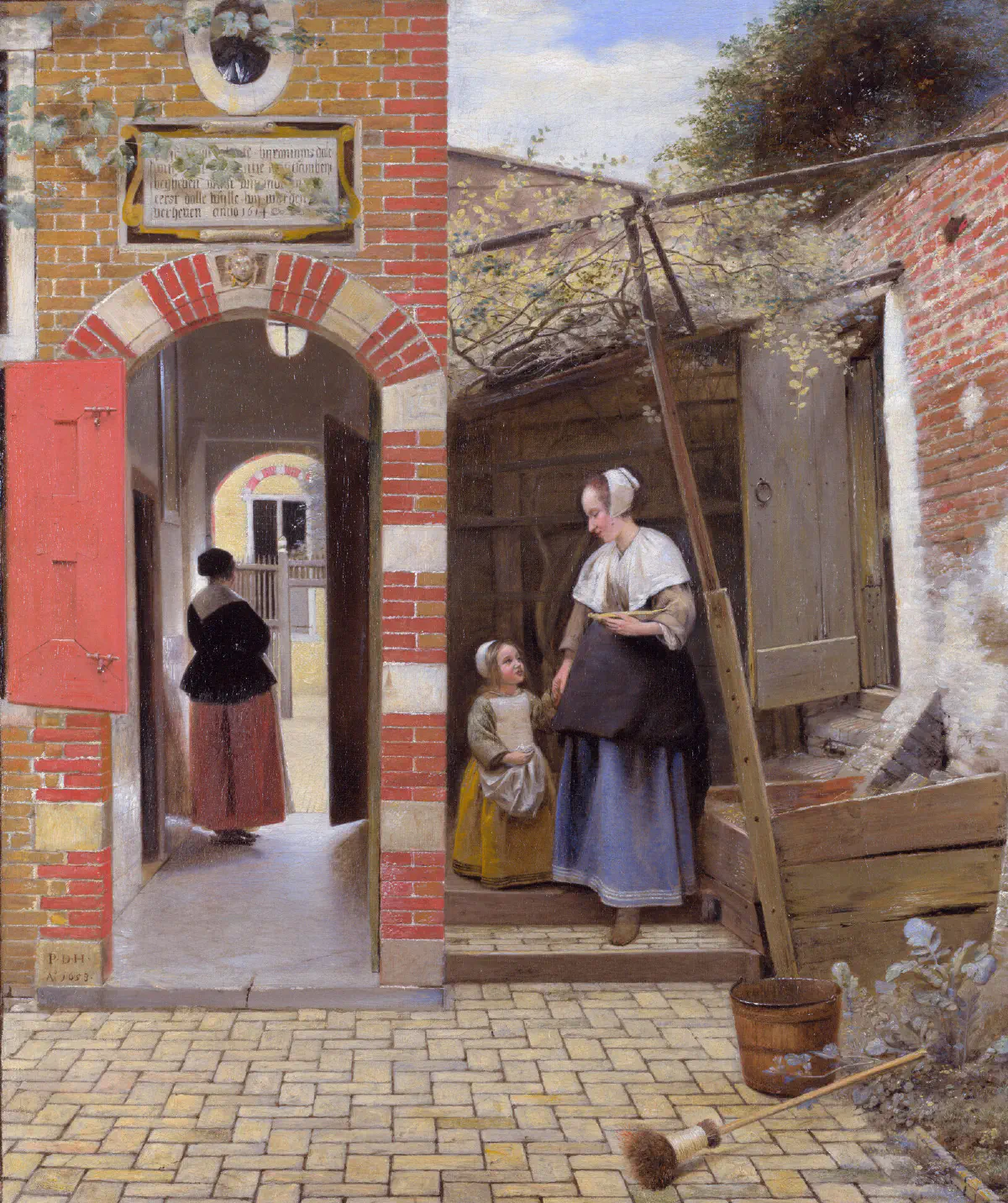
The Courtyard of a House in Delft
Pieter de Hooch, 1658, Oil on canvas, National Gallery, London Public Domain · SourceThrough the Doorway: Looking Slowly with Pieter de Hooch
There is a doorway at the back of this courtyard, and Pieter de Hooch gives us every reason to look through it. First comes a strip of tiled floor. Then an old brick arch. Beyond it, a dim passage, a woman in shadow and, at the far end, a glimpse of the houses across the way. The little journey takes only a moment. You can make it again and again.
The Courtyard of a House in Delft, painted in 1658 and now in the National Gallery in London, does not announce itself with a grand event. A young maid holds a child’s hand near a flight of steps. A broom and bucket have been left on the ground. Sunlight reaches the walls and paving. The longer you look, the more carefully the ordinary scene seems to have been arranged.
A house with more than one way out
Start with the arch on the left. De Hooch makes its bricks and pale stone blocks substantial enough to feel as though they might be cool under your hand. The passage draws the eye towards the street, while its dark interior makes the bright opening beyond look brighter still. A red shutter opens towards us on the left; another door stands open at the top of the steps on the right. This is an enclosed courtyard that keeps offering glimpses elsewhere.
The paving helps organise the space. Its lines lead us in, but they also hold the foreground together, giving the maid and child a firm place within the architecture. On the right, the painting loosens: a vine spills across a fence, the wall is worn, and wooden boards lean around a log bin. Compare those irregular edges with the deliberate brickwork of the arch. One half feels built and measured; the other has been left to weather and grow. Neither is quite as tidy as a diagram.
De Hooch knew Delft well. He joined its painters’ guild in 1655, three years before this picture, according to the National Gallery’s account of the artist. His paintings often attend to domestic spaces and the people who occupy them. Here, the setting is not merely a backdrop. Its openings, corners and changes of light give the figures their particular places and make us aware of the distances between them.
The people in the light
The maid stands with the child just above the courtyard floor. Their joined hands make a small, unmistakable connection in a picture full of walls and doorways. The National Gallery reads their exchange as affectionate; it is a generous interpretation, though the painting leaves us room to look for ourselves. The maid also holds a dish, but we cannot tell what is in it. Nor can we make out what the child carries in her apron.
Look next at the figure in the passage. She is farther away, partly hidden by shadow, and turned towards the houses outside. The Gallery suggests that she may be the child’s mother, but her identity is not known. That uncertainty matters. If we assume a complete family story, we risk looking past what de Hooch actually gives us: three figures in different parts of a house, linked by the space but not all facing one another.
The broom and bucket in the foreground invite another sort of speculation. A broom can carry symbolic meanings in Dutch paintings, and the Gallery suggests that here it may point to an orderly household as well as to the maid’s work. That is a useful possibility, not a key that opens every door. Before turning the broom into an emblem, notice its practical presence: someone has been working here, and for the moment the work has stopped.
An inscription and an open question
Above the arch is a stone tablet, partly veiled by leaves. The National Gallery identifies it as a relic from a former nunnery on the site. Its inscription refers to patience and humility, and to descending before being raised. What those words are meant to contribute to this particular scene is less certain. They give the doorway a history without explaining the people beneath it.
The Gallery also places the painting alongside seventeenth-century writings about household management and the roles expected of women. Such ideals can help us understand the culture in which a picture was made, but they are not a transparent record of how every household lived. De Hooch’s courtyard is a constructed image, not a documentary photograph with the dust left in.
Still, the dust seems imaginable. So do the worn boards, the uneven wall and the pause before someone picks up the broom. Follow the passage to the bright street once more, then return to the maid and child. The painting lets us travel beyond the courtyard, but it gives us plenty of reasons to stay.
Sources and image credit
- National Gallery: The Courtyard of a House in Delft, collection entry and catalogue information.
- National Gallery: Pieter de Hooch, artist biography.
- Image: Pieter de Hooch, The Courtyard of a House in Delft, 1658, National Gallery, London. Wikimedia Commons; public domain.
