
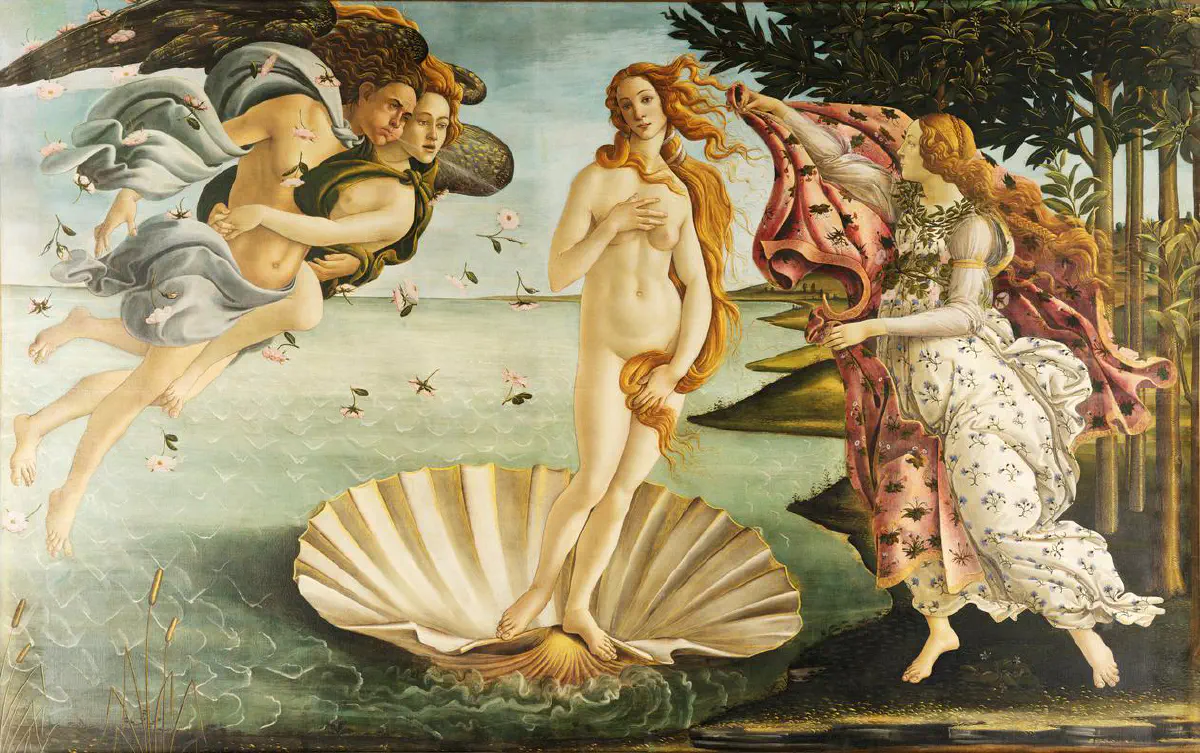
The Birth of Venus
Sandro Botticelli, c. 1484–1486, Tempera on canvas, Uffizi Gallery, Florence Public Domain · SourceThe Birth of Venus: The Famous Painting That Gets Its Own Story Slightly Wrong
You probably know the picture: a woman on a giant shell, long hair in the sea wind, and two figures blowing her toward shore. The surprise is in the title. Botticelli’s Venus is not being born in front of us. She has already emerged from the sea as a fully grown goddess and is arriving on land. The title The Birth of Venus became established much later, in the nineteenth century. The painting is really showing the next scene: a divine arrival with very impractical transport.
Sandro Botticelli probably painted it around 1484–1486. He made it in Florence, during the Italian Renaissance, when artists and their learned advisers were bringing stories from ancient Greece and Rome into new paintings. A large nude female figure drawn from classical mythology was an unusual choice in Western painting of the period. Botticelli did not make her a study in realistic anatomy, though. He made her a moving line: her body curves, her hair streams, and the whole scene seems to float rather than stand firmly on the ground.
Follow the wind
Start on the left. The winged wind god Zephyrus blows Venus toward shore. A second winged figure blows beside him; she is often identified as Aura, a personification of a light breeze, though other identifications have been proposed. Their breath is made visible in the long lines of air and the drifting roses. On the right, one of the Horae—the goddesses associated with the seasons—holds out a flower-patterned cloak. Her dress suggests that she is the Hora of Spring.
Try tracing the movement with your eyes: from the wind gods, across Venus’s hair, and toward the waiting cloth. The figures are not arranged like people posing for a group portrait. They form a current, carrying your attention from one side of the painting to the other. Even the cloak is caught in that motion.
A shell, a pose, and a little unreality
Venus stands on a scallop shell so large it belongs to myth, not the local beach. Her hands echo an ancient pose known as Venus Pudica—“modest Venus”—in which the goddess covers her body. But Botticelli’s version does not obey the rules of a life study. Her neck and torso are elongated, and her balance would be difficult to maintain in real life. The figures cast no shadows. This is not a mistake-ridden attempt at realism; it is a world built to make line and movement matter more than physical weight.
That choice helps explain why the painting feels both calm and strange. Venus looks composed, but her hair and the surrounding fabric are in motion. She seems to arrive without quite touching the world beneath her. If you have ever tried to hold a pose while a strong wind catches your coat, you know how much the painting is asking your body to ignore.
Gold, canvas, and a changing palette
The work is on canvas, rather than the more expensive wooden panel used for many paintings of the period. Technical examination has also revealed that Botticelli changed some details as he worked. The figure on the right originally wore low classical sandals, and the collar on the cloak was added later. Gold highlights appear in the hair, wings, fabrics, shell, and landscape; apparently, Botticelli applied this gold after the painting had been framed.
Time has altered the colours, too. Some green pigment has darkened, and the blues of the sea and sky have lost brightness. So the version you see today is not a perfect window onto the colours Botticelli first planned. The painting has had a life after the painter put down his brush.
What does Venus mean here?
There is no single agreed explanation for the painting’s full meaning. Some scholars connect Venus to Renaissance ideas about beauty and divine love. Others have explored whether the mythological scene could have had a role in wedding imagery. The identity of the original patron is also uncertain: a Medici commission has often been proposed, but the evidence does not settle the question.
You do not need to solve that debate to read the picture. A useful starting point is simpler: a goddess arrives, the wind moves her, and a springtime figure prepares to clothe her. The famous title encourages us to look for a moment of birth. Botticelli gives us a moment of arrival instead. That small correction changes the scene from an origin story into a threshold: Venus is between sea and shore, myth and human life, motion and stillness.
Next time you see the painting, do not stop at the shell. Follow the wind to the cloak, then ask yourself whether Venus looks as if she is standing—or if Botticelli has made her hover just above the world.