
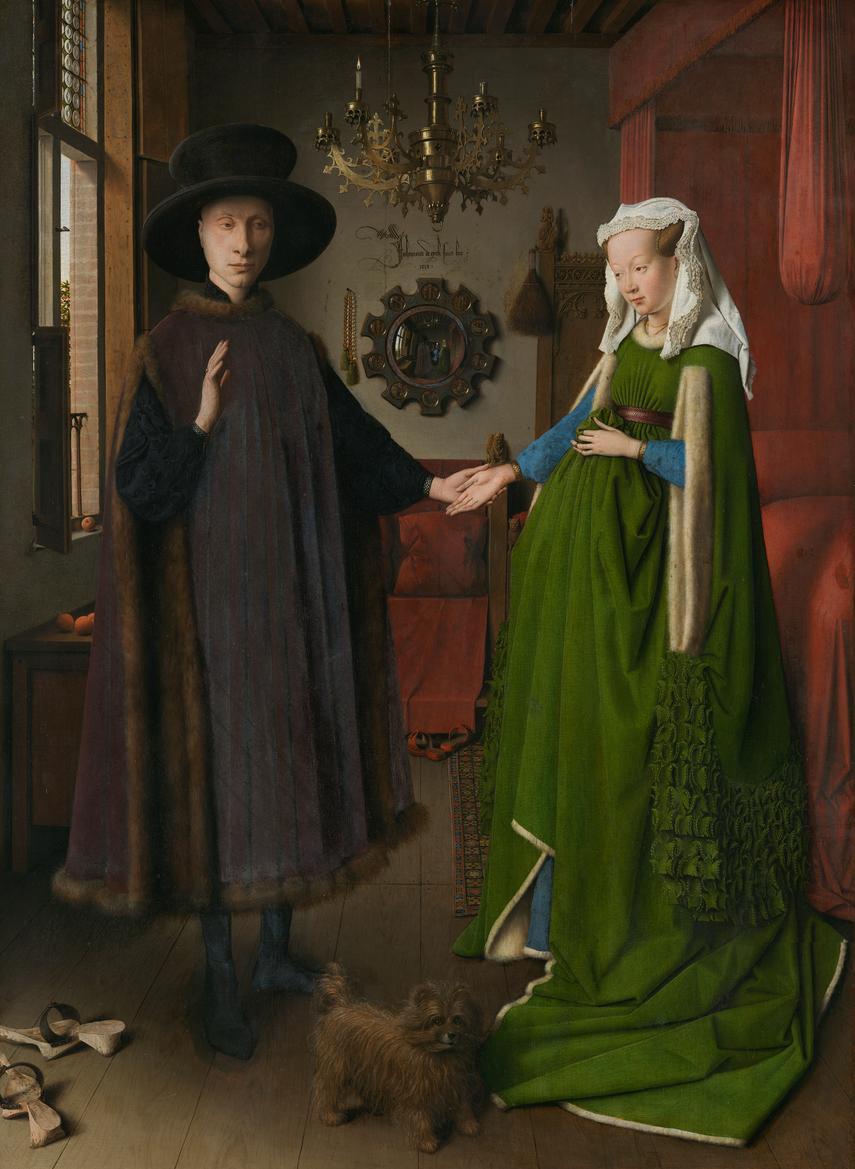
The Arnolfini Portrait
Jan van Eyck, 1434, Oil on oak panel, National Gallery, London Public Domain · SourceJan van Eyck, 1434 · Oil on oak panel · National Gallery, London
THE GUIDE: Don’t call it a wedding certificate
The familiar story says this is a wedding, and that Jan van Eyck signed the wall as a witness. That is an interpretation, not a settled fact. The sitters’ identities are uncertain, and scholars disagree about whether the scene records a marriage, another legal arrangement, a memorial, or something else. Read the visible evidence first. Do not let a tidy story do the looking for you.
Step 1: Notice how the room is arranged
The man stands close to the window; the woman is nearer the bed. Their placement makes the room feel divided into zones, not simply filled with furniture. The window opens onto the outside world; the bed occupies the domestic interior. That division can carry ideas about gender and household roles, but it does not by itself tell us who these people are or what event is taking place.
The figures face us, but they do not perform the same action. He raises a hand; their other hands meet. The pose has the formal quality of an oath or agreement. That makes a contractual reading plausible. It does not make it proven.
Step 2: Look into the mirror
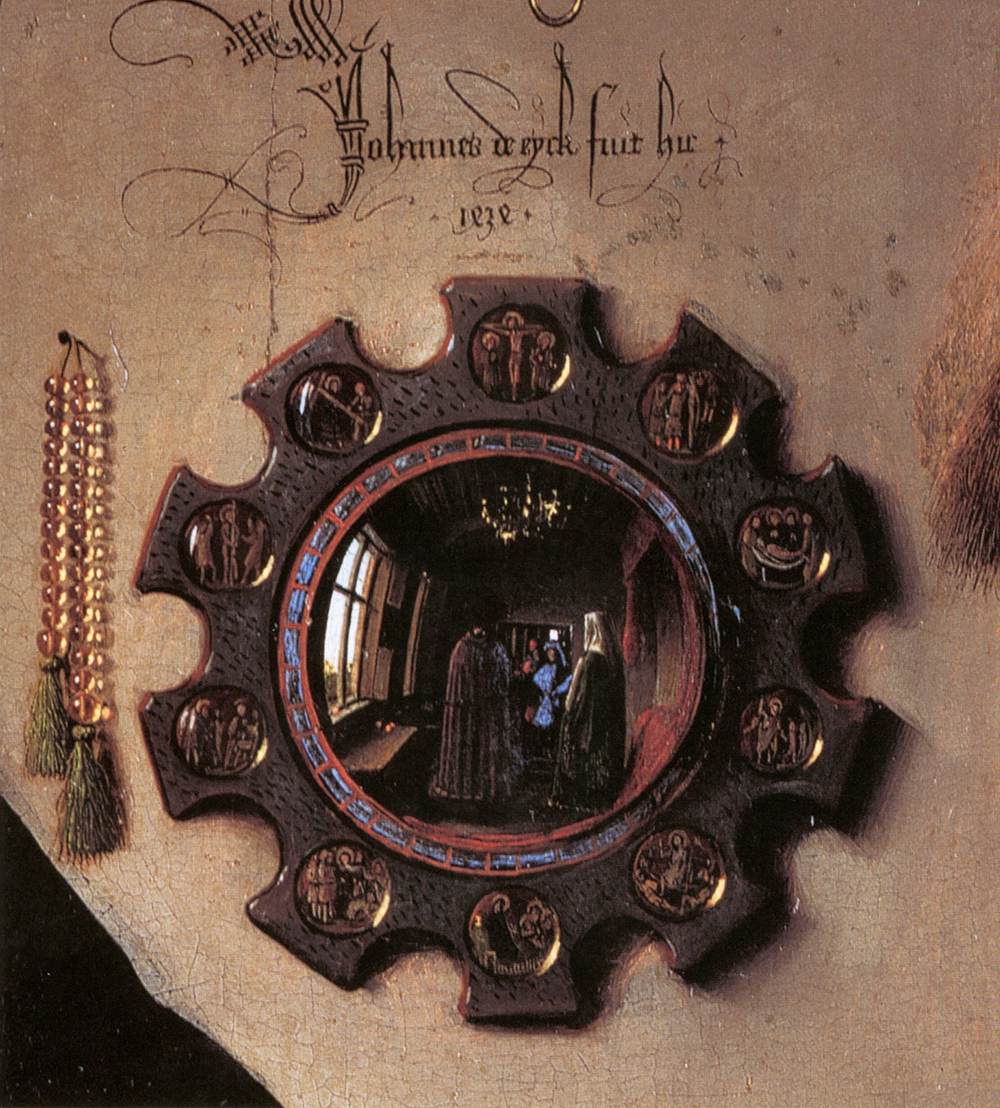
The convex mirror is not just a miniature of the room. It expands the picture space: you see the couple from behind and two figures in the doorway. The reflection makes you ask who is present beyond the couple—and whether the painted scene is meant to be witnessed.
One of the reflected figures is often identified as the painter. That is a possibility, not a fact the image confirms. The mirror’s tiny scenes around its frame show episodes from the Passion of Christ, adding religious meaning to an interior that also displays worldly goods.
Step 3: Read the signature carefully
Above the mirror, the inscription reads “Johannes de eyck fuit hic 1434”—“Jan van Eyck was here 1434.” It makes the painter’s presence part of the scene. It does not literally say “I witnessed this marriage.” Treat the distinction as important: the signature supports the idea of testimony, but it cannot settle what kind of event, if any, is being recorded.
Step 4: Ask what the objects are doing
The chandelier, richly dressed figures, bed hangings, carpet, and oranges make wealth visible. Oranges were expensive imports in the region, according to the painting’s historical account. These things are not neutral decoration: they help construct a picture of prosperity. But do not turn every object into a secret code. The meaning of many details is debated, and some may be signs of status or ordinary furnishings rather than symbols with one fixed translation.
Step 5: Look at the paint, not just the story
Van Eyck worked in oil on oak. Thin, translucent layers of glaze helped create the work’s saturated colour and precise differences between surfaces. Light from the window catches objects across the room, making wood, fabric, metal, and glass feel distinct. The technical achievement matters because it makes the room persuasive. The painting’s realism is carefully built, not a transparent window onto an unquestionable event.
That is the useful correction: The Arnolfini Portrait is not a puzzle with one answer hidden in a dog, a candle, or a mirror. It is a tightly staged image that makes presence, status, and possible agreement visible—while leaving the exact occasion unresolved. Learn to separate what the painting shows from what viewers want it to prove.
Nameplate · The Arnolfini Portrait · Jan van Eyck · 1434 · Oil on oak panel · National Gallery, London · Image: Wikimedia Commons, Gennadii Saus i Segura · Public domain