
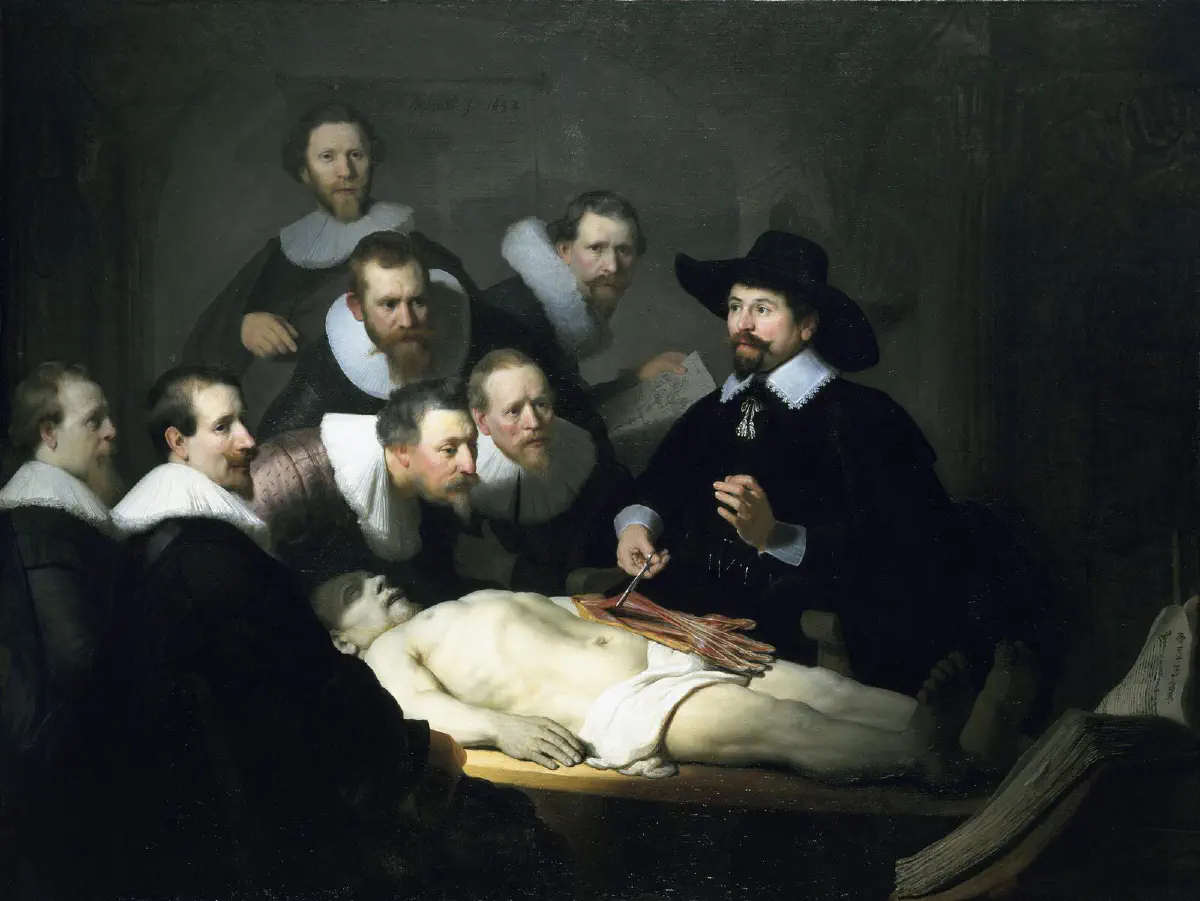
The Anatomy Lesson of Dr Nicolaes Tulp
Rembrandt van Rijn, 1632, Oil on canvas, Mauritshuis, The Hague Public Domain · SourceStop calling this a medical photograph. Rembrandt’s painting is a commissioned group portrait, built to make its paying subjects memorable. The dead man is not a diagram, and the scene is not a neutral record of a lesson.
Visual grammar: how the picture directs your eye
1. Composition — one body, many witnesses. The corpse stretches across the foreground, while the living men gather above it. Their heads form a loose arc, but the body gives the image its strong horizontal line. You read the group as a public event, not as a private exchange between teacher and student.
2. Gesture — watch the hand, not the title. Tulp lifts and works the muscles of the corpse’s left forearm. The surrounding men do not all look at the same thing: some focus on the demonstration, while others face outward toward us. That split turns the scene into both an anatomy lesson and a portrait of men being seen at once.
3. Light — the corpse is not just evidence. The body is brightly exposed against a dark ground. Its face is partly shaded, a detail associated with the “shadow of death” and with Rembrandt’s use of light and dark. The contrast makes the body impossible to ignore, but it also gives the scene a dramatic, almost staged quality.
4. Props — the missing tools matter. There are no cutting instruments in view. At the lower right, an open anatomy book supplies a different kind of authority: this is a learned demonstration as well as a spectacle. The painting’s account says the book may be Vesalius’s De humani corporis fabrica, but that identification is not certain.
5. Context — a group portrait wearing a science costume. The event is dated to 31 January 1632. Amsterdam’s Surgeons’ Guild permitted one public dissection a year, and the body had to be that of an executed criminal. This one was Aris Kindt, convicted of armed robbery and executed earlier that day. The surgeons paid to be included in the portrait; Rembrandt arranged them into a dramatic scene rather than documenting a typical dissection. In a usual lesson, the chest would have been opened first, since its organs decayed fastest.
That last point is the useful correction: the painting is about anatomy, but it is not reliable reportage of how an anatomy lesson normally unfolded. Look again and you can see the two jobs it performs at once: display the body, and display the men gathered to study it.
Try this in the gallery: cover the corpse with your hand for a moment. The assembled faces become a conventional group portrait. Uncover the body, and the scene turns into a confrontation with death. Rembrandt needs both readings; the tension between them is the point.
Image: Rembrandt, 1632. Oil on canvas. Mauritshuis, The Hague. Public domain via Wikimedia Commons.