
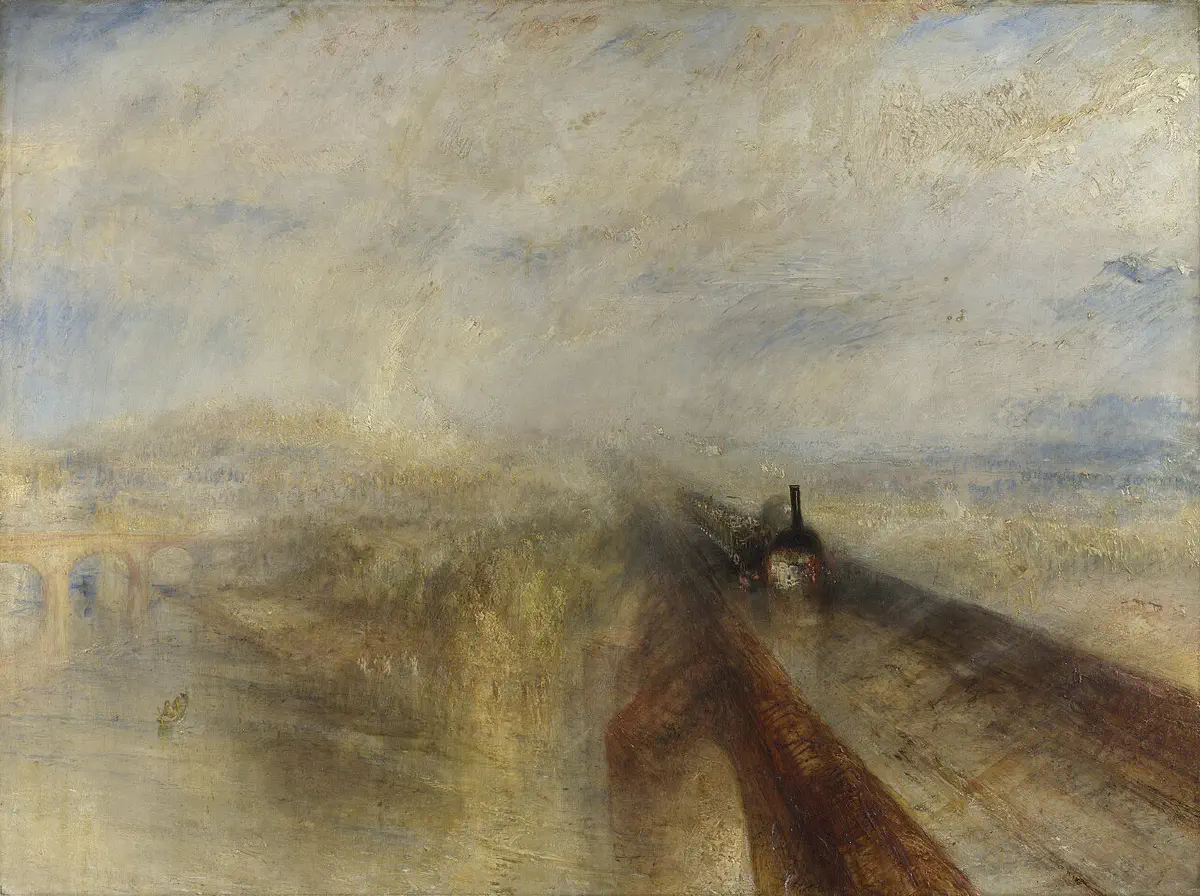
Rain, Steam and Speed
J. M. W. Turner, 1844, Oil on canvas, National Gallery, London Public Domain · SourceThere is a hare running along the track ahead of the train. You cannot see it in the painting anymore. The paint Turner used for that small detail has gone transparent with age, and the hare vanished sometime in the late nineteenth century. But it survives in an 1859 engraving made while the painting was still fresh, and in the memory of a boy named George Leslie who watched Turner add it the day before the work went on exhibition at the Royal Academy in 1844. According to Leslie, the hare, not the train, was meant to represent speed.
That story matters because it tells us what Turner was actually doing. He was not painting a locomotive. He was painting an allegory of forces: rain falling, steam dissipating, speed rushing forward. The train is the vehicle, not the subject.
The bridge is real. It is the Maidenhead Railway Bridge designed by Isambard Kingdom Brunel, completed in 1838, carrying the Great Western Railway across the Thames between Taplow and Maidenhead. We are looking east towards London as the train heads west. The viaduct recedes with an exaggerated foreshortening that pulls the eye toward the horizon, and that compression is what makes the train feel as though it has just burst out of the weather. Turner reduced the double rail track to a single narrow line. He brushed the paint lightly, almost carelessly, so that the engine seems to materialise from the haze rather than sit firmly on the canvas.
Stand close and the painting dissolves into smears and scrapes of pigment. Stand back and the train acquires weight and momentum. This is not an accident. Turner understood that a painting of speed must behave differently at different distances, just as a moving object looks different when it is far away than when it is near. The rain is not a uniform veil. It falls steadily but not heavily, and shafts of sunlight break through onto the woods and fields on either side of the bridge. On the river to the left, a small boat moves slowly.
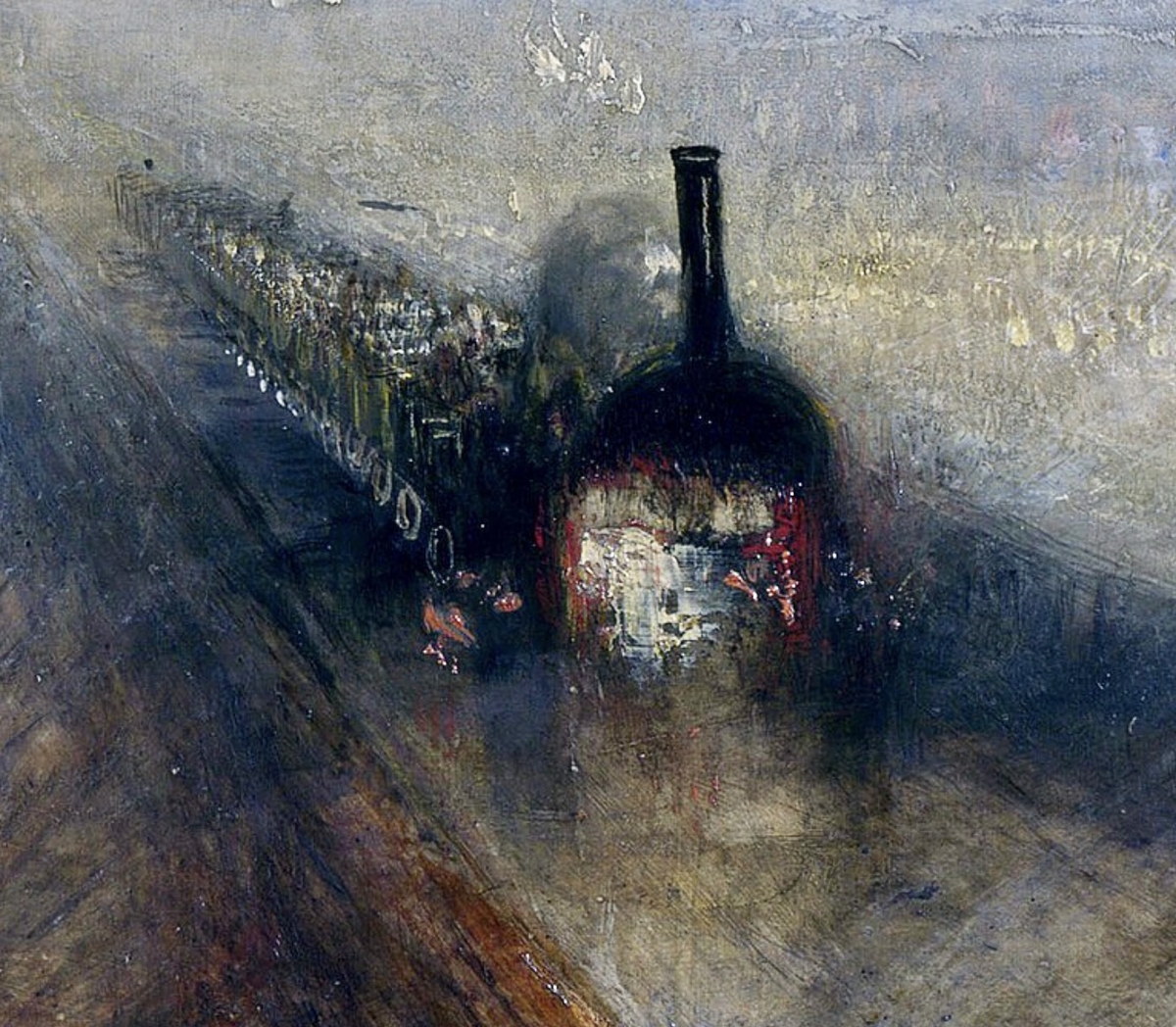
The detail above shows what the eye does first: the engine is almost nothing but chimney and firebox, a dark mass that exists because everything around it is haze. Turner painted the fire not only red but blue and pea-green, and left the front housing off the boiler so the glow inside is visible. The puffs behind the engine are spaced out in the air to visualise the speed at which it has passed.
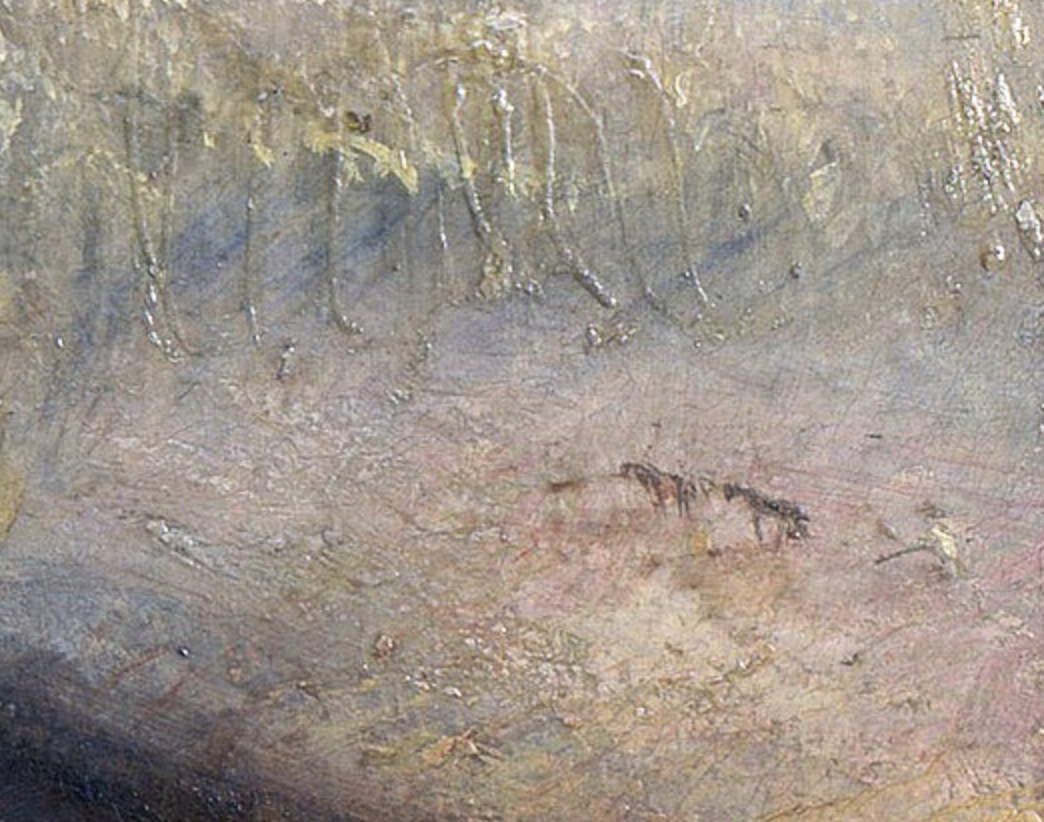
Near the right edge, barely visible at full size, a man drives a horse-drawn plough. These are the old speeds, the pre-industrial rhythms. The train does not erase them. It rushes past them.
Turner was not hostile to modernity. He travelled on steam trains himself and painted them more than once. What interests him here is not whether the railway is good or bad, but how paint can make an experience tangible. Turner painted what he saw, not what convention expected.
The painting entered the National Gallery as part of the Turner Bequest in 1856, two years after Turner’s death. It has been in Room 40 ever since, hanging where visitors can stand close enough to see the brushwork and far enough away to feel the train move. The hare is gone. Everything else remains.
Sources
- National Gallery collection entry: Rain, Steam, and Speed – The Great Western Railway
- National Gallery catalogue entry (Judy Egerton, 2000)
- Art UK artwork record
- Image: Wikimedia Commons, public domain (artist died 1851)
- Detail, locomotive: Wikimedia Commons, public domain.
- Detail, ploughman: Wikimedia Commons, public domain.


