
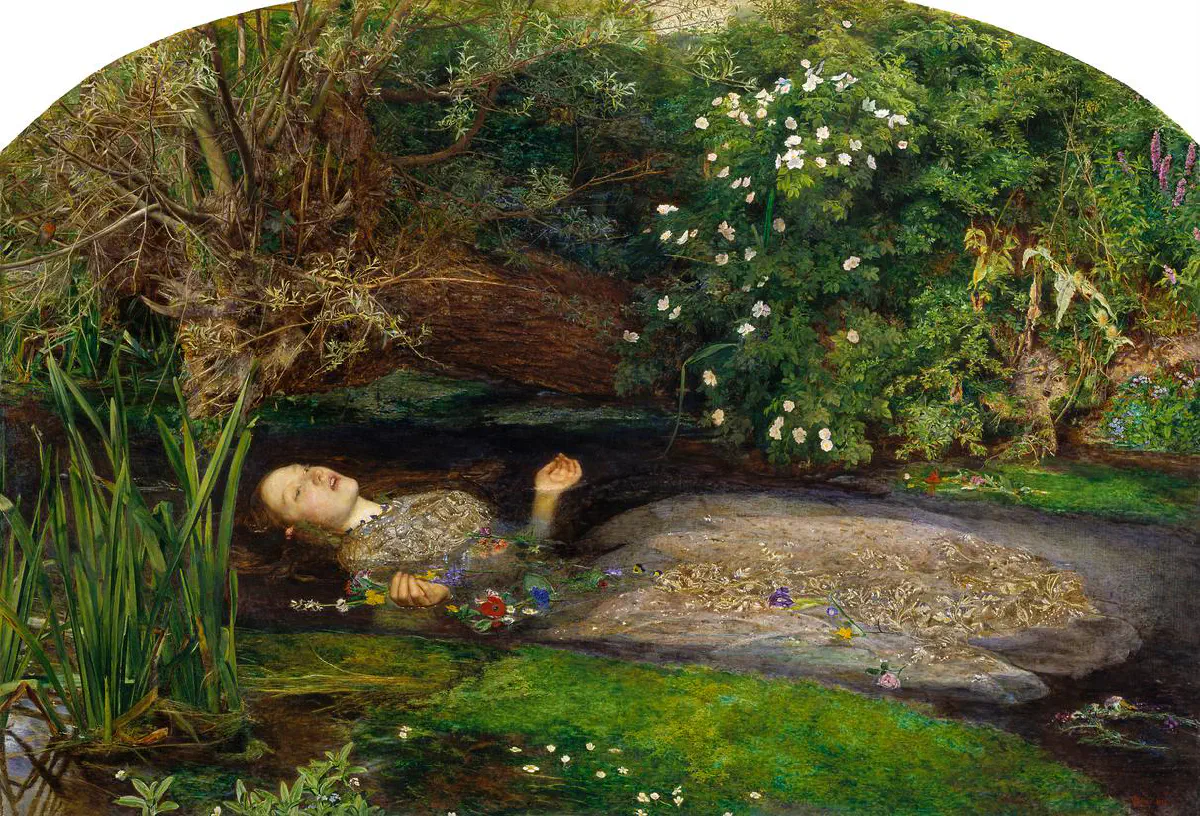
Ophelia
John Everett Millais, 1851–1852, Oil on canvas, Tate Britain, London Public Domain · SourceOphelia: Millais Makes You Look at the River
You may know the image before you know the story: a young woman floating among flowers, her face turned upward, her hands open. Millais painted Shakespeare’s Ophelia at the moment she is drowning. It is a beautiful scene, but beauty is not the same as safety. Look at her hands: they are still above the water, and yet they are not reaching for help.
Millais worked on Ophelia between 1851 and 1852. The woman who posed for Ophelia was Elizabeth Siddal. That fact gives the painting a human presence beyond the character from Hamlet: this is not simply a face invented to illustrate a play. Someone had to hold that pose while Millais built the scene around her.

Now pull your eyes away from Ophelia for a moment. The plants, flowers and water occupy almost as much attention as the figure. The landscape does not fade into a convenient backdrop; it presses close around her. Millais makes you scan it, as if the river were asking you to keep looking even when you would rather look away.
That is the painting’s quiet tension. Ophelia’s body appears still, while the natural world around her is packed with detail. The result is not a simple portrait of a tragic heroine. It is a scene in which a person is becoming part of the landscape—and the viewer has arrived too late to change what happens.
When you see the painting, try this: follow the line of the water before looking at Ophelia’s face. Then return to her open hands. Do they look peaceful to you, or helpless? The answer can change the whole mood of the picture.
Image note: Ophelia (1851–1852), John Everett Millais. Oil on canvas. Tate Britain, London. Painting image and detail via Wikimedia Commons; public domain.