
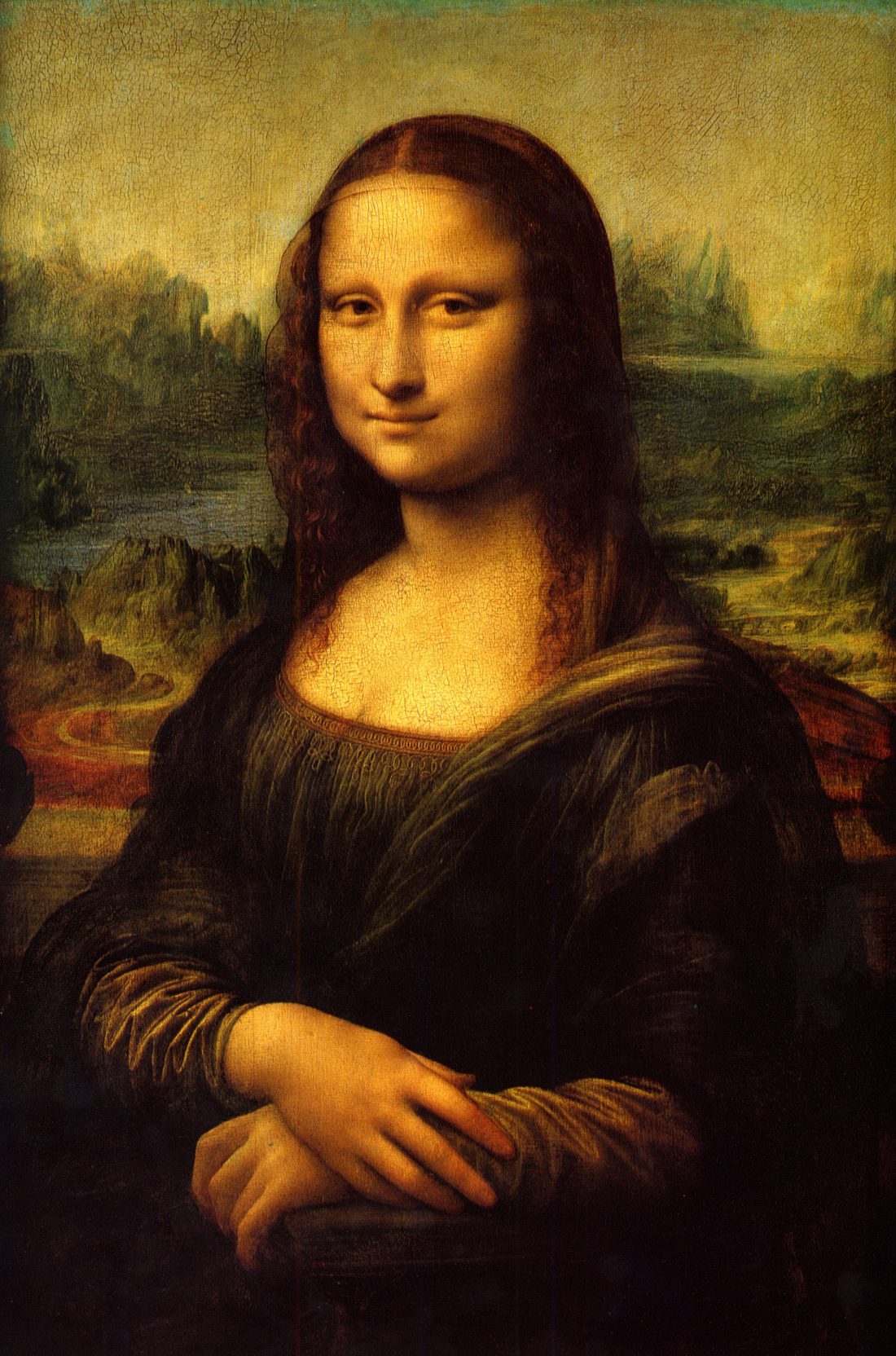
Mona Lisa
Leonardo da Vinci, c. 1503–1506, Oil on poplar panel, Musée du Louvre, Paris Public Domain · SourceThe smile without edges
Look at the corners of her mouth and the outer edges of her eyes.
There is no dark line telling you where her lips end and her cheek begins. Most Renaissance portraits relied on clean contours to separate skin from air. Leonardo abandoned them. Instead, he laid down dozens of translucent oil glazes, so thin that the transitions look like smoke curling into a dim room. He called this technique sfumato.
Because the edges are soft, your brain cannot fix her mood in place. Glance directly at her mouth, and the shadows flatten out. Look at her eyes, and the corners of her lips seem to lift. She is not performing a mystery for us. She is simply refusing to freeze.
A chair and a wild horizon
She sits upright in a pozzetto armchair, her hands resting quietly on the armrest. Her posture comes straight out of Florentine etiquette, reserved and dignified. She was Lisa del Giocondo, the wife of a local silk merchant, dressed in dark silk with a simple veil across her hair.
Behind her shoulder, the world turns strange.
Leonardo did not paint Florence. He placed her on an open loggia looking out over icy peaks, winding paths, and a distant four-arched bridge. Notice where he set the horizon. It does not run behind her neck, the way earlier portraits did. It cuts across the level of her eyes. That single choice ties her gaze directly to the wild mountains behind her, making an ordinary merchant’s wife feel as permanent as rock.
The accident of fame
For four hundred years, this modest poplar board was admired by painters and quiet connoisseurs, but it was not a global spectacle. That happened on a Monday morning in August 1911.
A handyman named Vincenzo Peruggia, who had helped build the painting’s protective glass case, lifted the panel off the wall, tucked it under his workman’s coat, and walked out of the Louvre. He kept it in a trunk in his Paris boarding house for over two years, convinced he was returning looted treasure to Italy. The international manhunt, the empty space on the gallery wall, and the sensational headlines in Paris and New York turned her into the most famous face on earth.
What time wore away
People often wonder why her face looks so smooth, almost alien, without eyebrows or eyelashes.
She was not plucked clean. In 2007, high-resolution scans revealed microscopic traces of single brush hairs around her brow and eyelids. Leonardo painted them. Over five centuries of varnishing and aggressive cleaning wiped those delicate strokes away, leaving behind the bare, polished brow we know today.
Standing in the Louvre behind the velvet rope, with hundreds of phone screens raised around you, it is easy to forget how quiet this picture actually is. It is just seventy-seven centimetres of white poplar, painted by a man who spent years softening shadows so that paint could breathe.