
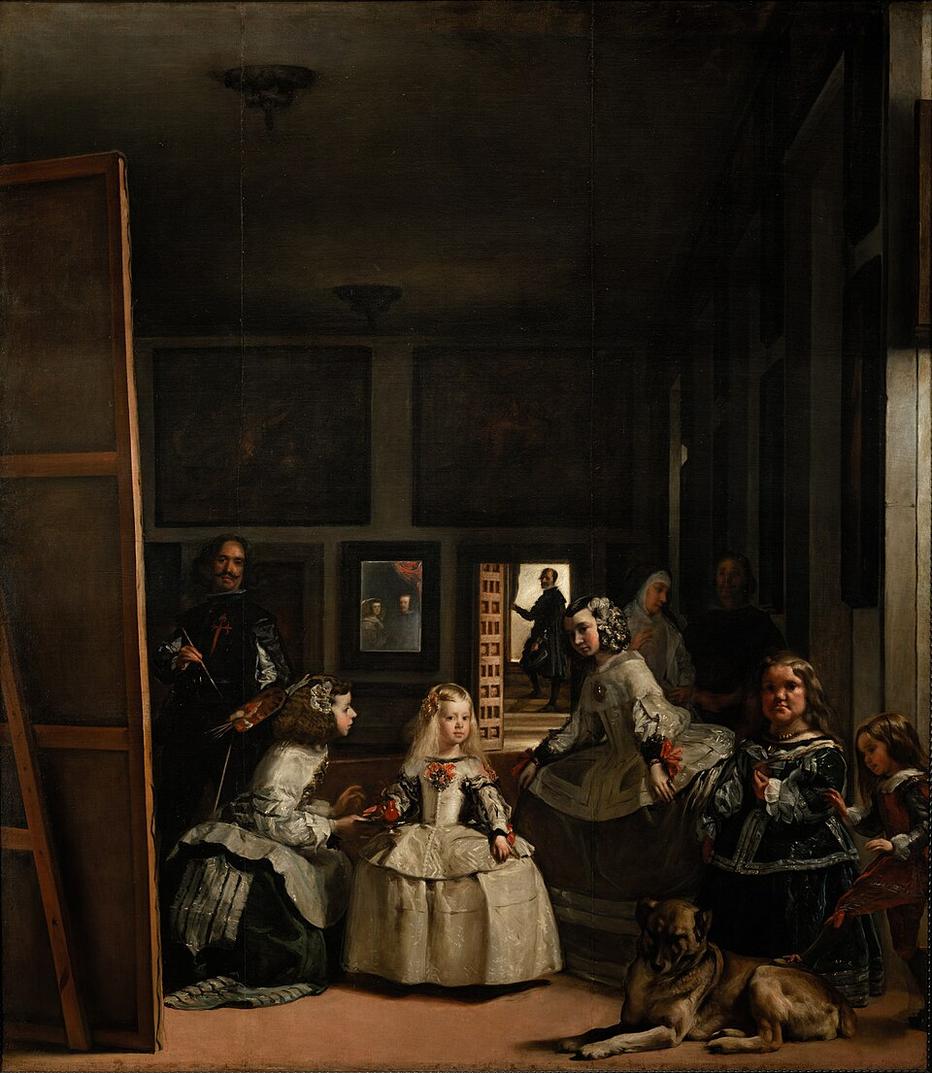
Las Meninas
Diego Velázquez, 1656, Oil on canvas, Museo del Prado, Madrid Public Domain · SourceLas Meninas: Who Is Looking at Whom?
A young princess stands in the middle of the room. Her attendants hover around her. A dog naps near a dwarf’s shoe. At the left, a painter pauses beside a canvas so large that we cannot see what he is painting. And in the back wall, a mirror holds a small, startling image: the king and queen.
That is the scene in Diego Velázquez’s Las Meninas, painted in 1656. It looks like a moment caught in passing. But the moment has a problem: where, exactly, are you standing?
The five-year-old Infanta Margarita is the bright centre of the gathering. One maid kneels to offer her a drink; another is poised in a curtsey. The people around her do not all look at the same thing. Some look out toward us. Velázquez looks out too, brush in hand. The mirror seems to put the king and queen on our side of the picture.
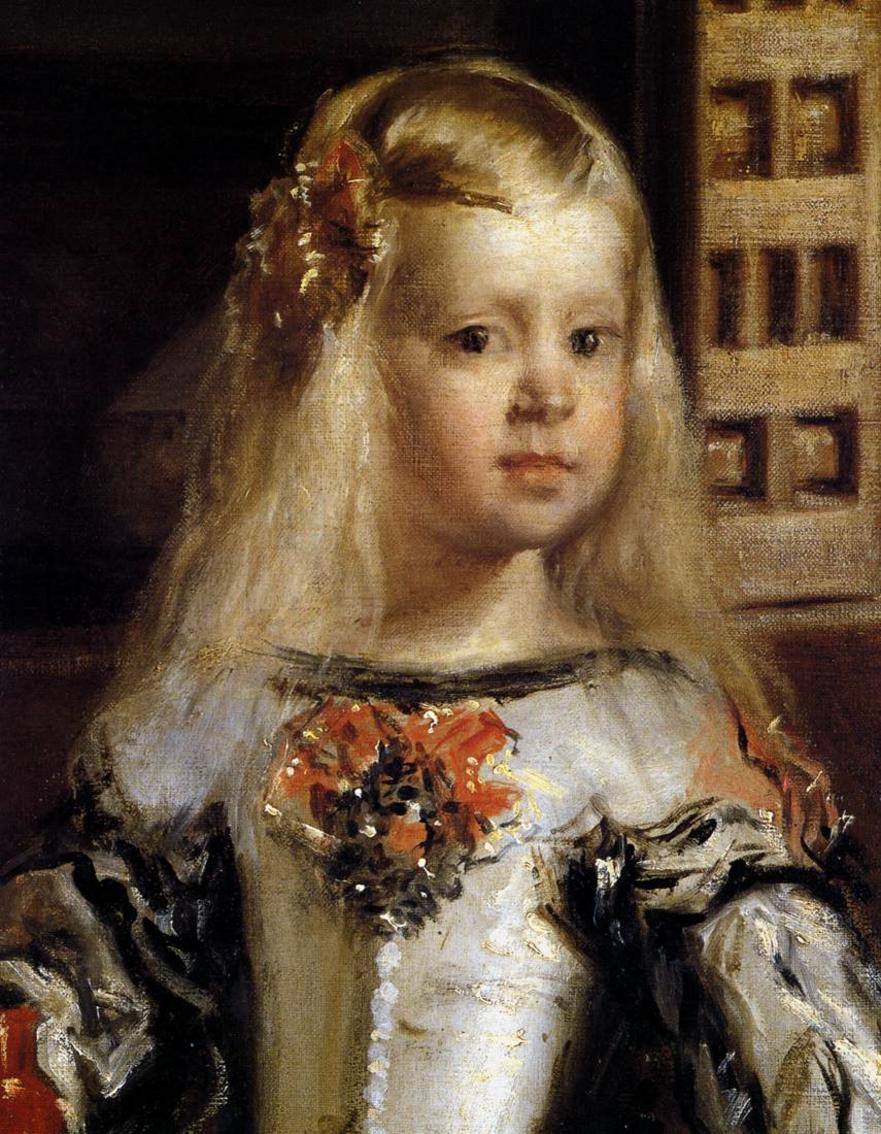
Try a small experiment: look at the mirror, then at the painter, then at the figures looking outward. The picture keeps shifting your role. Are you a visitor watching the royal household? Are you standing where the king and queen stand while Velázquez paints them? Or does the mirror reflect the royal portrait on the unseen front of the canvas? The last possibility has been argued by some art historians, but there is no universally accepted answer.
That uncertainty is not a puzzle you have failed to solve. It is part of the painting’s design. Velázquez makes the space beyond the frame matter as much as the room he shows. Even the man in the bright doorway deep in the background seems suspended between arriving and leaving. Your eye travels into the room, then gets pulled forward again by the mirror and the people facing out.
Velázquez was not simply a painter invited to record royal life. He worked at the court of Philip IV, and his own rise there mattered. In a period when painting was often treated as a craft rather than a liberal art, he places himself inside the royal scene, at work, and on a scale that gives the artist a striking presence. The red cross on his chest was added after he received the Order of Santiago in 1659, three years after the painting was made.
The canvas has had a life beyond the moment it depicts. It was damaged in the 1734 fire that destroyed Madrid’s Alcázar and later restored. Its earliest recorded name was La Familia (“The Family”); the title Las Meninas appeared in the Prado catalogue in 1843. Even the name we use now arrived later.
So when you stand in front of Las Meninas, do not rush to identify every face and declare the mystery solved. Notice how the little mirror makes the absent monarchs present, and how Velázquez makes room for himself without stepping out of the scene. Then ask the painting its simplest, most inconvenient question: who is the viewer here—you, the king and queen, or all of you at once?