
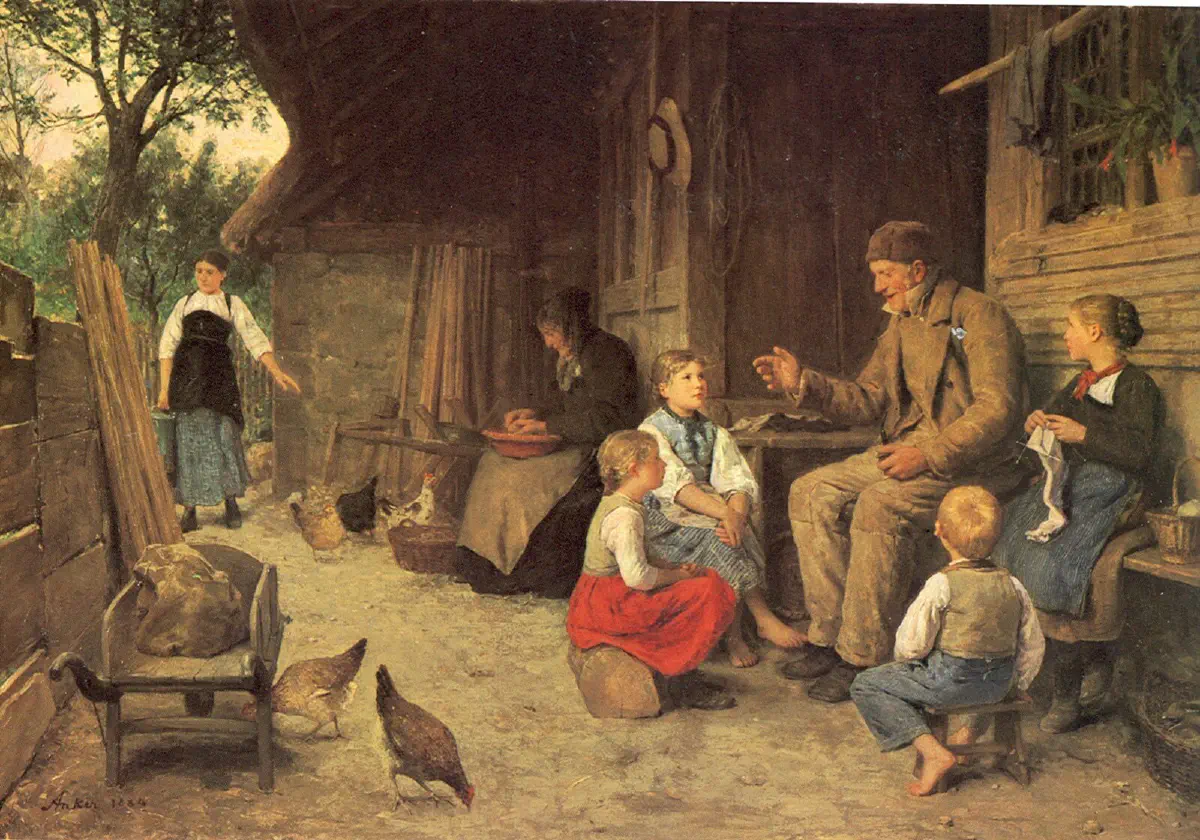
Grandfather Telling a Story
Albert Anker, 1884, Oil on canvas, Kunstmuseum Bern, Bern Public Domain · SourceA hand raised in the quiet
Look at the grandfather’s right hand. It is raised just above his knee, palm turned slightly upward, fingers relaxed. He is not slamming a fist onto the table or acting out a battle. He is simply holding the thread of a tale, and five children have stopped everything to follow where it leads.
Albert Anker painted Der Grossvater erzählt eine Geschichte in 1884 in Ins, the rural village in the Bernese Seeland where he was born and kept his studio. While Victorian painters often turned grandparents and village children into sugary greeting cards, Anker gives this room weight and gravity. The room is dim, the wood is scrubbed, and nobody is performing for an audience outside the frame.
The circle around the bench
The composition gathers inward like a circle drawn around a hearth. The old man anchors the left, seated in his dark waistcoat with spectacles tucked away and pipe resting nearby. His weathered face catches the daylight coming through an unseen window.
Each child listens differently. The older girl on the bench leans her cheek on her hand, lost in thought. A small boy perches on a stool right in front of the grandfather, leaning forward with his elbows pressed to his knees. Behind the bench, two older children stand quietly, their eyes fixed on the speaker. Even the girl with knitting needles has paused her hands mid-stitch. Anker does not treat childhood as one generic mood. He records five distinct ages of attention.
Notice the floor beneath their feet. A few scattered toys, a basket, and a hen pecking near the wood stove keep the scene rooted in daily farm chores. Storytelling here is not a special occasion with tickets and stage lights. It happens in the working space between afternoon chores and evening soup.
Paris training, Seeland soil
Anker is often called Switzerland’s national painter, a title that can make his work sound conservative or insular. Yet his technique was thoroughly cosmopolitan. He trained in Paris under Charles Gleyre alongside young artists like Claude Monet and Pierre-Auguste Renoir. He exhibited regularly at the Paris Salon, earning medals and international buyers.
What set Anker apart was where he chose to apply that academic polish. Every summer, he left the Parisian art world and returned to his family home in Ins. He painted the people he lived beside: farmers, teachers, schoolgirls with slates, and village elders. His surfaces are smooth and controlled, but his observations are sharp. Look at the coarse wool of the boys’ trousers, the grain of the wooden table, and the worn leather of the grandfather’s boots. Everything has been handled and repaired.
What stays in the room
The painting offers no moral lesson and no grand historical subject. It records a moment of speech that we cannot hear, passed from an old generation that remembered earlier times to children who would live into the twentieth century.
Stand before the canvas for a minute and watch the light fall across the table. The warmth does not come from nostalgia. It comes from Anker’s patient respect for ordinary people sitting together in the quiet of an afternoon.
Sources and image credit
- Kunstmuseum Bern: Albert Anker, permanent collection records and biographical archives.
- Sandor Kuthy and Therese Bhattacharya-Stettler, Albert Anker: Werkkatalog der Gemälde und Ölskizzen, Kunstmuseum Bern, 1995.
- Image: Albert Anker, Der Grossvater erzählt eine Geschichte (Grandfather Telling a Story), 1884, Kunstmuseum Bern. Wikimedia Commons; public domain.
