
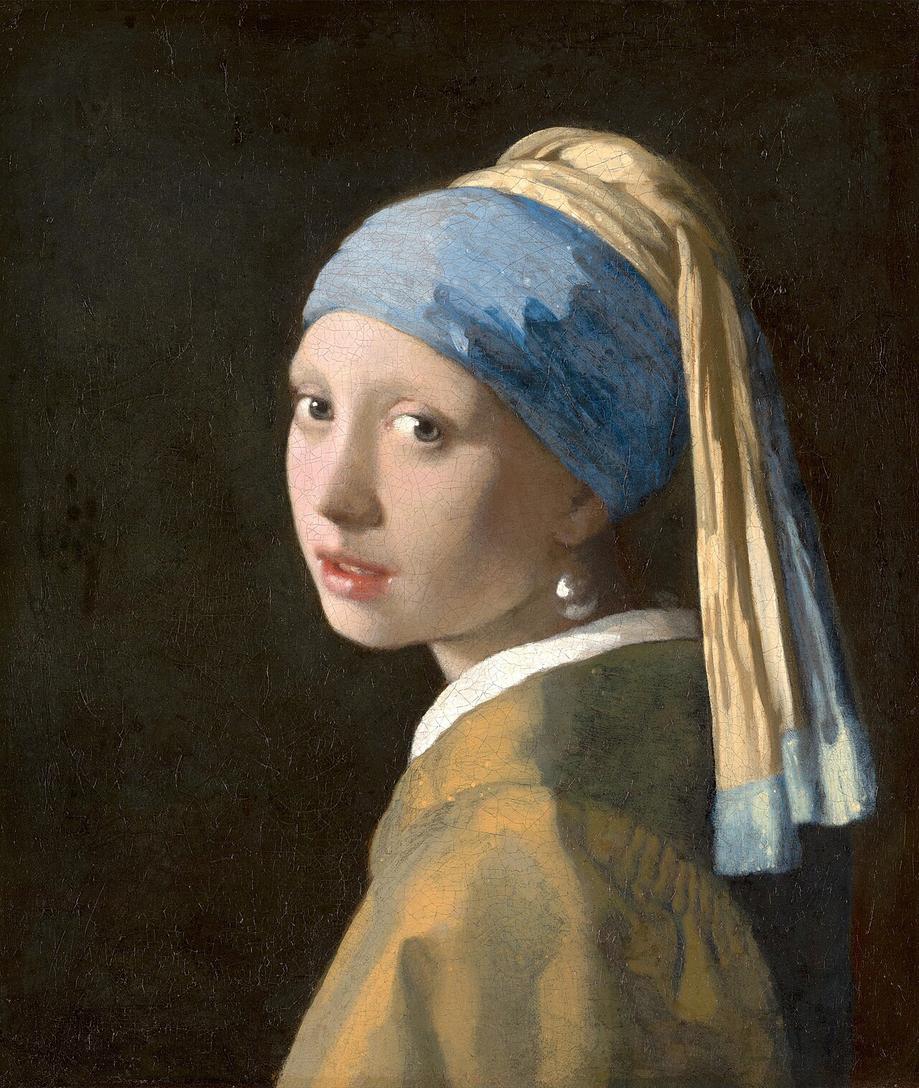
Girl with a Pearl Earring
Johannes Vermeer, c. 1665, Oil on canvas, Mauritshuis, The Hague Public Domain · SourceThe look across the shoulder
She turns around as if you just spoke to her. Her lips are slightly open. Her eyes look straight into yours.
We do not know who she was. She was not a wealthy client paying for a portrait. In seventeenth-century Delft, painters made character studies called tronies. They used them to practice facial expressions, strange costumes, and strong light. Vermeer was not painting a person for history. He was testing what paint could do.
The earring is an illusion
Look closely at the earring.
There is no hook going through her ear. There is no outline around the circle. You see a bright dab of lead white on top and a soft gray reflection from her collar below. That is all. Your brain fills in the rest and turns two marks of paint into a heavy drop.
A real pearl that size was nearly impossible to find in the seventeenth century. It would have cost a fortune. Vermeer likely used a drop of lacquered glass or polished tin as a prop in his studio. In the painting, he only needed two brushstrokes to convince you.
What changed in the dark
For a long time, people thought she stood in an empty black void.
In 2018, conservators scanned the canvas with X-rays and microscopes. They found traces of a green curtain behind her. Over three hundred years, the green glazes made of plant dyes faded and turned dark. She was never floating in outer space. She was standing in a normal room.
The scans also solved the mystery of her face. People often thought Vermeer left off her eyelashes to make her look like a statue. Under the microscope, conservators found tiny brown brush hairs along the edges of her eyelids. He painted eyelashes, but the paint wore down over time.
The costume and the blue paint
Her clothes were not everyday Dutch fashion. Women in Delft did not walk through town in silk turbans. Vermeer kept costume pieces in his studio to catch light and texture.
The blue fabric on her head uses ultramarine. It came from lapis lazuli mined in Afghanistan, ground down by hand and shipped across continents. It cost more than gold. Even when money was tight, Vermeer paid for the best blue he could buy.
The appeal of this canvas is not a secret story. It is simple craft. Vermeer put a few marks of white, blue, and shadow on a piece of cloth, and four hundred years later, it still feels like she just noticed you.