
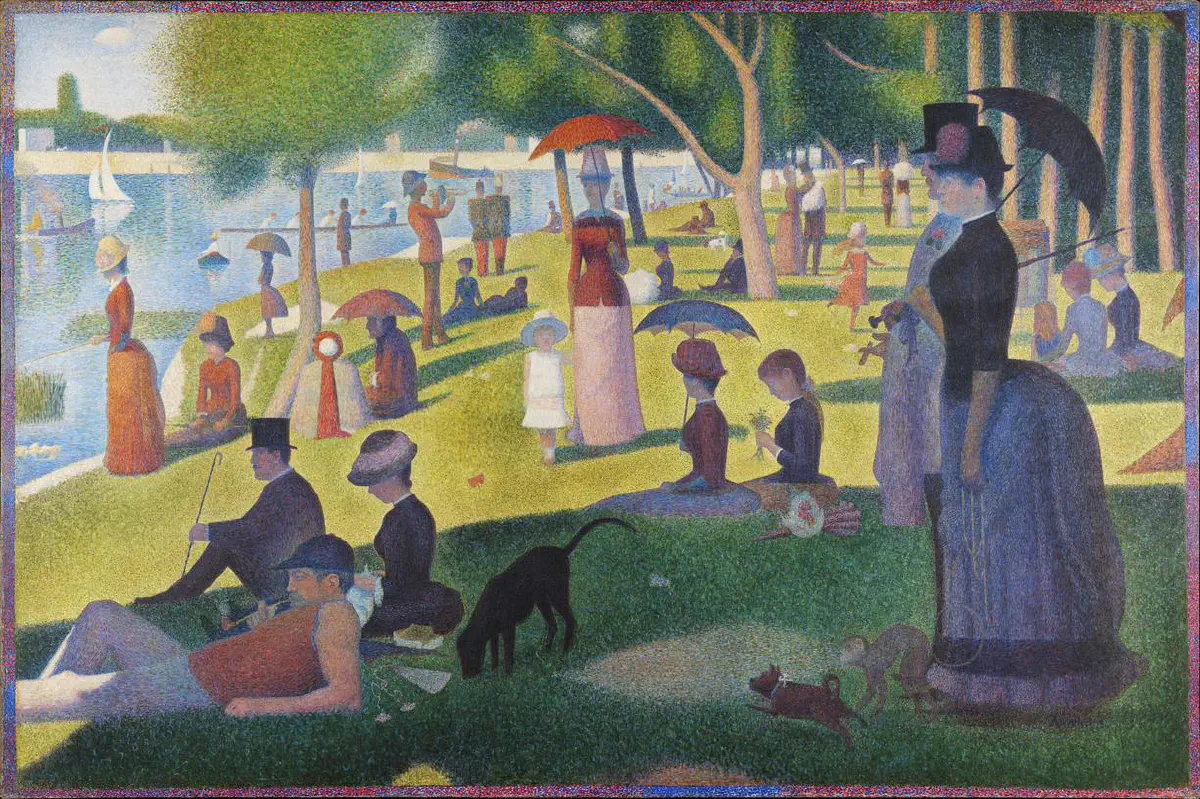
A Sunday Afternoon on the Island of La Grande Jatte
Georges Seurat, 1884–1886, Oil on canvas, Art Institute of Chicago Public Domain · SourceA Sunday afternoon with a very precise painter
At first, this looks like a picture of people doing almost nothing: strolling, sitting, fishing, watching the river. Stay with it for a moment. The scene is calm, but it has been built with extraordinary care. Georges Seurat worked on A Sunday Afternoon on the Island of La Grande Jatte from 1884 to 1886, preparing numerous drawings and oil sketches before finishing this canvas, which is about three metres wide.
The island was a riverside retreat just outside Paris. Seurat fills it with people from different walks of life, but he does not paint them as a loose, passing crowd. They stand and sit in clear shapes, like pieces set carefully into a large pattern. The result is not a snapshot of a busy day. It is a composed, almost still world.
The dots are a method, not a gimmick
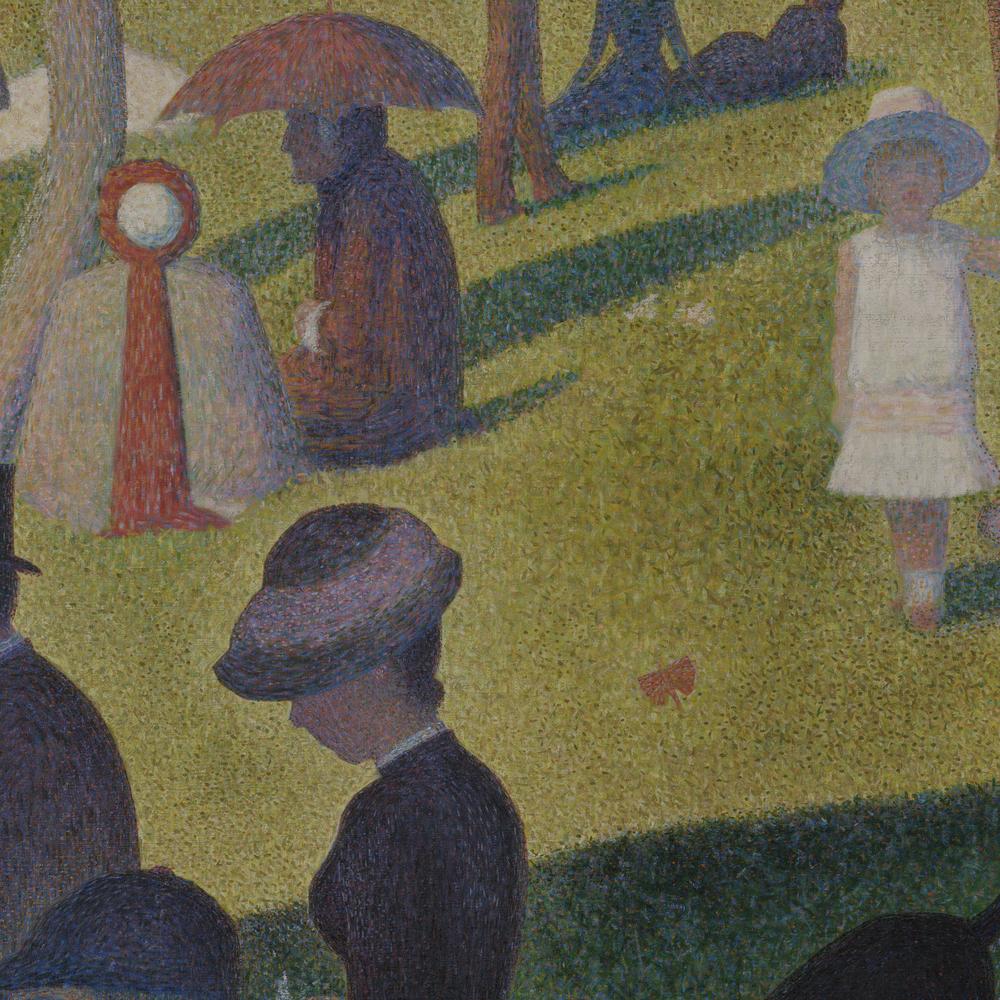
Seurat wanted color to work in the viewer’s eye. Instead of blending all his colors together on the canvas, he placed small marks of neighboring colors side by side. From a distance, the eye combines them into a single impression. Seurat preferred the term Divisionism; the technique is also widely called Pointillism.
Here is a useful way to look: step back until the marks merge, then move closer until they separate again. You are not just inspecting a surface. You are taking part in the painting’s color-making process. Seurat used the small, regularly spaced dots in the second year of his work on the picture, after making earlier studies and sketches.
One small figure changes the whole encounter
Find the girl in white near the center. Unlike most of the people around her, she stands in sunlight rather than shade, and she looks straight out at you. You can feel the painting’s careful stillness suddenly turn into a meeting of gazes. She does not explain the scene; she makes you aware that you are looking at it.
Then scan the edges. On the right, a fashionable woman walks with a monkey on a leash. On the left, another woman holds a fishing rod over the water. The fishing may carry a second meaning: the area was associated with prostitution among the bourgeoisie, and the rod has been read as a possible allusion. Treat that as an interpretation, not a hidden label Seurat left for us.
The title promises a Sunday afternoon. Seurat gives you that leisure, but he also makes you notice how people occupy the same place without quite sharing the same moment. The figures seem to pause inside a scene designed down to its smallest marks. That tension is part of the picture’s hold: it is a crowd, and yet each person appears sealed in their own quiet.
Seurat’s painting first appeared at the eighth and final Impressionist exhibition in 1886. It is now in the collection of the Art Institute of Chicago. The image may look restful from across the room. Up close, it is a highly deliberate experiment in how seeing works.
Image note: Georges Seurat, A Sunday on La Grande Jatte (1884–1886). Image via Wikimedia Commons; public domain.